
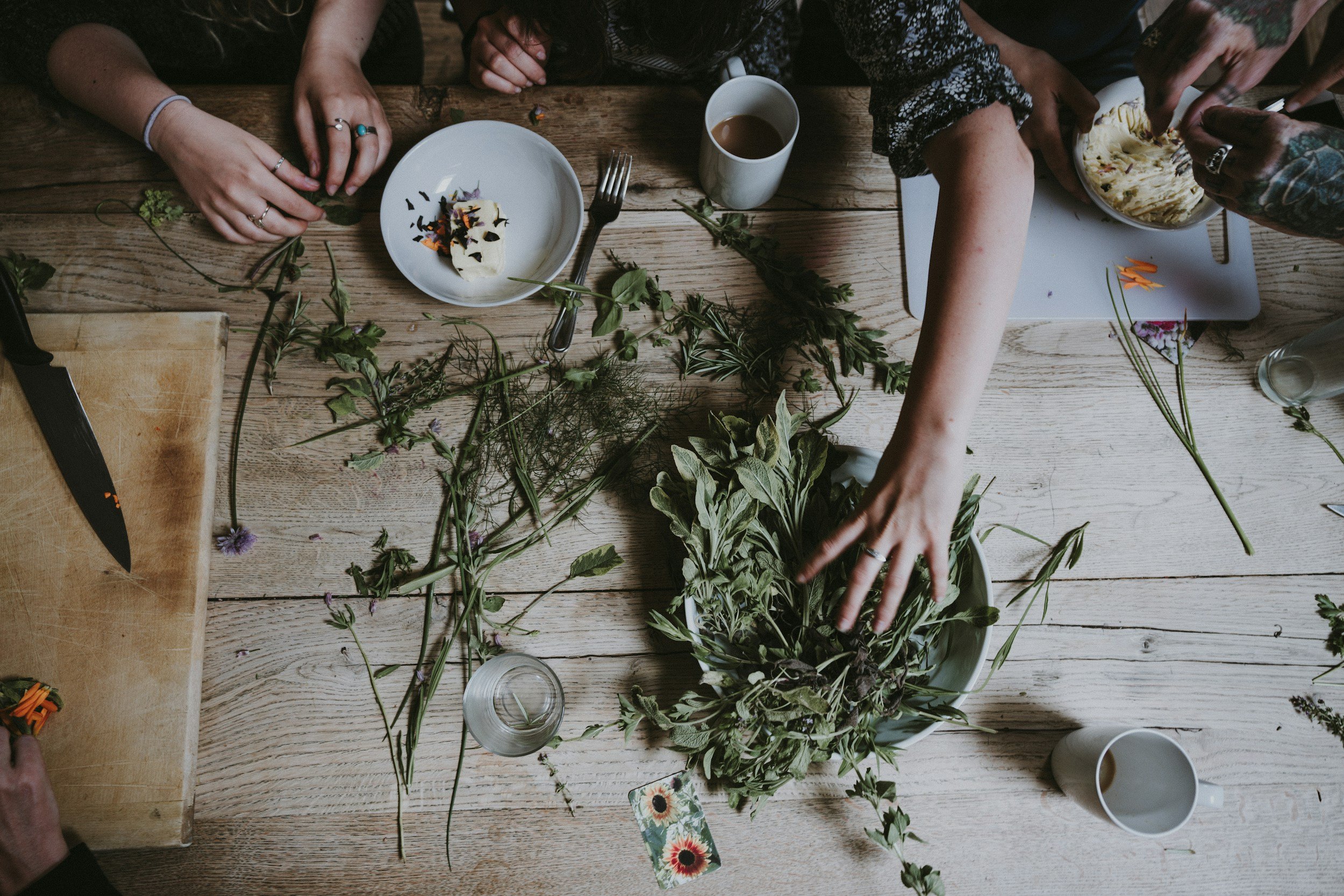
herbs

release exterior
-
key: simultaneous chills/fever
wind cold:
more chills than fever
itchy throat
clear sputum
body aches
no thirst
floating moderate or tense pulse
thin white tongue coat
chills not relieved with more clothes
wind cold excess = no sweat
wind cold deficiency = sweating
wind heat:
more fever than chills
dry sore throat
yellow sticky sputum
thirst
floating rapid pulse
thin white tongue coat or red tip with thin white or yellow coat
-
ma huang: 2-9g
acrid, warm, bitter
lu, ub
promotes sweat, releases exterior, open lung qi, calm wheeze, promotes urination
gui zhi: 3-9g
acrid, warm, sweet
lu, ub, ht
promote sweat, release exterior, open channels, warm and unblock yang
zi su ye: 5-9g
acrid, warm, aromatic
lu, sp
release exterior, harmonize MJ, circulate qi, calm fetus, relieve seafood poisoning
jing jie: 4.5-9g
acrid, warm
lu, lv
expel wind, release exterior, alleviate pain, alleviate itch, vent rash, stop bleeding
fang feng: 4.5-9g
acrid, warm sweet
ub, lv, sp
expel wind, release exterior, alleviate pain, stop spasms, stop itch, spread liver
qiang huo: 3-9g
acrid, warm, bitter, aromatic
ub, kd
disperse wind cold damp upper body, taiyang headache
bai zhi: 3-9g
acrid, warm
lu, st
expel wind, yang ming headache, open nasal passage, expel pus, dry damp
xi xin: 3-9g
acrid, warm
lu, kd
expel cold, toothache, shao yin headache, warm lung, transforms cong fluid
xin yi hua: 3-9g
acrid, warm
lu, st
only opens nasal orifices, sinusitis
xiang ru: 3-9g
acrid, warm, aromatic
lu, st
relieve summer heat, trans damp, promote urination to lower edema
sheng jiang: 3-9g
acrid, warm
lu, sp, st
release exterior, warm MJ, transform phlegm, stoop vomit, release toxin ban xia, seafood
gao ben: 3-9g
acrid, warm
ub
dispel wind cold damp, alleviate pain, jueyin/vertex headache
-
niu bang zi: 6-12g
acrid, bitter, cold
lu, st
disp wind heat, benefit throat, vent rash, moisten intestines
bo he: 3-6g
acrid, cool, aromatic
lu, lv
disp wind heat, clears eyes/throat, vent rash, spread liver
chan tui: 3-9g
sweet, cold
lu, lv
disp wind heat, clear eyes, vent rash, alleviates spasms
sang ye 4.5-9g:
sweet, bitter, cold
goes to lung, and liver mai
expels wind, clears lung heat, brightens eyes, clears liver
ju hua: 4.5-15g
sweet, bitter, sl cold
lu, lv
disp wind, clear heat, brighten eyes, lv fire, relieve toxicity
ge gen: 9-21g
sweet, acrid, cool
goes to spleen and stomach mai
release muscles, generates fluids, reduces fever, vents rashes, treats diarrhea, raises yang
chai hu: 3-9g
acrid, warm, and slightly cold
goes to pericardium, liver, san jiao and gallbladder mai
releases exterior, reduces fever, resolves/guides shao yang, spreads liver, raises yang
sheng ma: 3-9g
acrid, sweet, slightly cold
lu, st, sp, li
rls ext, vent rash, clear heat, rel toxic, guide st chnl, raise yang
dan dou chi: 6-12g
sweet, slightly bitter, cold
goes to lung and stomach mai
releases exterior, wind heat or cold, eliminates irritability
man jing zi: 6-12g
acrid, bitter, neu
lv, st, ub
disp wind, clear heat, benefits eyes, only seed that ascends
mu zei: 3-9g
sweet, bitter, neu
lv, lu
disp wind heat, brighten eyes, stop bleeding
clear heat
-
key symptoms: fever, no chills, thirst
excess heat: high fever, copious sweating, thirst for cold water, rapid full pulse, red tongue, yellow coat
deficiency heat: low-grade fever in evening/night, night sweats, thirst for small sips or thirst for warm water, thready rapid pulse, red tongue, little or no coat
qi level heat: heat at the organ level, can affect many organs
ying level heat: irritability, shen disturbance, fever worse at night, thready rapid pulse, deep red tongue
blood level heat: ying level heat plus bleeding, unconscious, convulsions
-
shi gao: 15-60g
sweet, acrid, cold
lu, st
clear heat, drain fire, qi level, xiao ke, external for sores
zhi mu: 6-12g
bitter, cold
lu, st, kd
clear heat, drain fire, nourish yin, generate fluids, moist intestine, deficiency/excess heat
lu gen: 15-30g
sweet, cold
lu, st
clear heat, generate fluids, clear st heat, stop vomit, clear lu heat
tian hua fen: 10-15g
sweet, cold, bitter
lu, st
clear heat, generate fluids, xiao ke, moisten lu, lower swelling
dan zhu ye: 6-9g
sweet, cold, bland
ht, si, st
clear heat, eliminate irritability, promote urine
huang lian: 1.2-9g
bitter, cold
ht, li, lv, st
clear heat, drain fire, ht/st, red eyes, dry damp, clear toxic
huang qin: 3-9g
bitter, cold
gb, li, lu, st
clear heat, drain fire lu/gb, shaoyang, dry damp, calm fetus
huang bai: 3-12g
bitter, cold
kd, ub
clear heat, drain fire kd, LJ damp heat, relieve toxic
long dan cao: 3-9g
bitter, cold
gb, lv, st
drain excess fire, lv/gb, LJ damp heat
zhi zi: 6-9g
bitter, cold
ht, lv, lu, st, sj
clear heat 3 jiaos, drain damp, relieve toxic, cool blood, stop bleeding
xia ku cao: 9-15g
bitter, acrid, cold
gb, lv
clear lv fire, lower hypertension, red eyes, dissipate nodules
ku shen: 3-9g
bitter, cold
ub, ht, lv, li, si
LJ damp heat, promote urine, kill parasites, stop itch
jue ming zi: 9-15g
bitter, cold, sweet
lv, kd, li
clear lv heat, brightens eyes, moistens intestines, lowers cholesterol
-
jin yin hua: 6-20g
sweet, cold
li, lu, st
clear heat, rel toxic, wei, qi, ying, and xue, level heat
liang qiao: 6-15g
btr, sl acd, cool
ht, lv, gb
wei or pc level heat, diss nodules, prom urin, unblock lin
pu gong ying: 9-30g
btr, swt, cold
lv, st
clear heat, rel toxic, sores, carbuncles, mastitis, jaundice
zi hua di ding: 9-15g
btr, acrid, cold
lv, ht
strongly clear tx heat, cool blood, stop bleeding, use for snakebite
da qing ye: 9-15g
btr, very cold
ht, lu, st
clear heat, rel toxic, cool blood, treat virus infection
ban lan gen: 9-15g
bitter, cold
ht, lu, st
clear heat, rel toxic, cool blood, ying/xue level heat, benefit throat
she gan: 3-9g
bitter, cold
lu
clear lu heat, benefit throat, trans phlegm
shan dou gen: 3-9g
btr, cold, sl tx
li, lu
clear heat, rel toxic, benefit throat, early stage cancer
bai tou weng: 6-15g
bitter, cold
li, lv, st
clear heat, rel toxic, cool blood, bloody dysentery, sores, carbunc
qin pi: 6-12g
btr, astr, cold
lv, gb, li, st
clr heat, dry damp, bloody dysentery, lv fire, ben eyes, disp w-d
bai jiang cao: 6-15g
acrid, bitter, cold
li, lv, st
clear heat, rel toxic, expel pus, invig blood, disp blood stasis
tu fu ling: 15-60g
swt, bland, neu
lv, st
rel toxic, elim damp, benefit joints, syphilis, turbid urin, LJ damp
-
sheng di huang: 9-15g
sweet, btr, cold
ht, kd, lv
clr heat, cool blood, ying/xue level, enrich yin, gen fluids
xuan shen: 9-15g
slty, swt, btr, cld
kd, lu, st
clr heat, cool bld, ying/xue, nourish yin, subdue fire, benefit throat
mu dan pi: 6-12g
acrid, btr, cool
h, lv, kd
clr heat, cool bld, ying/xue, invigorate, dispel stasis, lv fire, xu heat
chi shao: 6-15g
sour, btr, sl cold
lv, sp
clr heat, cool bld, ying/xue, invig bld, dispel stasis, lv fire
shui niu jiao: 6-15g
salty, cold
lv, ht
clr heat, cool bld, ying/xue, rel toxic, stop convuls, stop bleeding
-
qing hao: 6-12g
bitter, cold
kd, lv, gb
clr yin xu heat w/ vig fire, summer heat, damp heat, shaoyang, #1 malaria
bai wei: 3-12g
btr, salty, cold
lu, st, kd
clr xu heat, postpartum fever due to bld, xu, cool bld, ying/xue, unblk lin
di gu pi: 6-15g
sweet, cold
lu, lv, kd
clr xu heat, lu heat, xiao ke, hypertension, sweating
-
he ye: 3-9g
bitter, slightly sweet, neutral
ht, lv, sp
clear summer heat, raise clear yang, stop bleeding
xi gua: 15-30g
sweet, cold
ht, st, ub
clear summer heat, generate fluids, promote urine, aid jaundice
purgative
-
used for excess conditions in LJ
not for conditions in upper GI tract
da huang has caution pregnancy, mang xiao, and lu hui contraindicated in pregnancy
-
da huang: 3-15g
bitter, cold
li, st, lv, ht
purge accum, clr heat, drain fire, soften hardness, decrease swelling
mang xiao: 6-18g
btr, cld, acrd, slty
li, st
purge accum, clr heat, drain fire, soften hardness, decrease swelling
lu hui: 1.5-4.5g
bitter, cold
li, st, lv
purge accum, clr heat, drain fire, cool lv, kills parasites
fan xie ye: 1.5-3g
btr, sweet, cold
li
purge accum, clr heat, drain fire, xs constipation, ascites
-
huo ma ren: 9-15g
sweet, neutral
lv, sp, st
moisten intest, unblk bowels, nourish xu, prom urin, unblk lin
-
da ji: 1.5-3g
btr, cold, acrid, toxic
kd, li, lu
drive out cong fluid, edema, ascites, decrease swelling, clumps, contra preg
gan sui: 0.5-1.5g
btr, swt, cold, toxic
kd, li, lu
drive out cong fluids, decrease swelling, clumps, external use, contra preg
interior warming
-
cao wu: 1.5-3g
acrd, hot, btr, tx
ht, sp, lv
disp wind damp, disp cold, allev pn, xs cold pn
fu zi: 3-15g
acrd, hot, toxic
ht, sp, kd
rescue yang collapse, supp fire, disp cld, allev pn, cold bi
rou gui: 1.5-4.5g
acrd, hot, swt
ht, sp, lv, kd
supp fire, strgth yang, lead fire back to source, disp cld, allev pn
gan jiang: 3-9g
acrd, hot
ht, sp, lu, st
warm mj, rescue yang, unblk chanls, warm lu, trans cong fluid
gao liang jiang: 3-9g
acrd, hot
st, sp
st cold pn, warm mj, stop vomit
wu zhu yu: 1.5-4.5g
acrd, hot, btr, tx
lv, kd, st, sp
disp cld lv/st chnl, vertex ha, stoop vomit, stop diarrhea, decrease fire
xiao hui xiang: 3-9g
acrid, warm
lv, kd, st, sp
disp cold, lj pain, hernia, cold lv chnl, harmn st, dysmen
ding xiang: 1-3g
acrid, warm
kd, sp, st
warm mj, decrease reb st qi, disp cld, allev pn, warm kd, aid yang
chuan jiao: 3-6g
acrid, hot, sl tx
kd, sp, st
warm mj, allev pain, kill parasites, clear itch
hu jiao: 1.5-3g
acrid, hot
st, li
warm mj, disp cold, use powder in navel for abd pn, diarrhea
bi ba: 1.5-4.5g
acrid, hot
st, li
warm mj, disp cold, chest bi, #1 toothache
aromatic transform damp
-
key symptom: distention/fullness abdomen, nausea, vomiting, no thirst/appetite, stiffness, lethargy, greasy tongue, soggy or rolling pulse
aromatic herbs: cook no longer than 5-10 minutes
-
cang zhu: 3-9g
acrd, btr, warm
sp, st
strongest dry damp, disp w-d, d-h bi, rel ext, improve vision
hou po: 3-9g
acrid, btr, warm
sp, st, lu, li
prom mvmt qi, damp sp/st, decrease rebel qi, const, plum pit, wheeze
huo xiang: 3-9g
acrid, warm
sp, st, lu
trans damp, revive sp, elim turbid evil, sumr evil, rel ext, sinuses
pei lan: 3-9g
acrid, neutral
sp, st
trans damp, resolve summer evil
bai dou kou: 3-6g
acrid, warm
sp, st, lu
trans damp, prom mvmt qi, warm mj, stop vomit due to st cold
sha ren: 3-6g
acrid, warm
sp, st
trans damp, prom mvmt qi, food accum, sp xu, calm fetus
cao dou kou: 3-6g
acrid, warm
sp, st
dry damp, prom mvmt qi, cold damp injure mj
cao guo: 3-6g
acrid, warm
sp, st
severe cold damp mj, dry damp, check malaria
tonic
-
all qi and blood tonics are sweet
most yin and yang tonics sweet
sweet and cool tonifies yin
sweet and sour generates fluids
sweet and warm tonifies yang
sweet and acrid expels wind cold damp
tonics are usually cooked over low heat one hour and ingested before meals
combine with qi regulators to prevent cloying
-
sp qi deficiency: lethargy, weakness, lack of appetite, abdominal distention, loose stools, bleeding
lu qi deficiency: weak voice, SOB, shallow breathing, spontaneous sweating, pallid complexion
ren shen: 3-6g
swt, sl btr, warm
lu, sp
strong tonify source qi, tonify lu/sp, gen fluids, increase intel, calm spirit
dang shen: 6-9g
sweet, neutral
lu, sp
tonify qi, augment lu/sp, ton qi to gen blood, support righteous qi
huang qi: 9-15g
sweet, sl warm
lu, sp
tonify qi, raise yang, stab ext, prom urin, prom dischg pus, gen flesh
xi yang shen: 3-6g
swt, sl bitter, cold
lu, ht, kd
tonify qi, clr heat, gen fluids, yin xu w/ fire
tai zi shen: 9-30g
sweet, sl btr, neu
lu, sp
mildly tonify source qi, gen fluids
shan yao: 9-30g
sweet, neutral
lu, sp, kd
tonify all 3 jiaos, sp/st qi, lu/kd yin xu, xiao ke
bai zhu: 6-15g
swt, bitter, warm
sp, st
augment qi, strgth sp, dry damp, prom urin, stop sweat, calm fetus
bai bian dou: 9-30g
sweet, neutral
sp, st
strgth sp, chronic diarrhea, clr summer pathogen, transform damp
gan cao: 1.5-9g
sweet, neutral
12 channels
tonify ht/sp, moisten lu, stop cough, spasms, harmonize, rel toxic
da zao: 10-30g
sweet, neutral
sp, st
tonify sp/st, moderate properties other herbs
yi tang: 15-60g
sweet, sl warm
lu, sp, st
tonify mj, mod spasms, moisten lu, stop cough
jing mi: 9-15g
sweet, neutral
sp, st
tonify mj, aug qi, strgth sp, often used as envoy
-
dang gui: 4.5-15g
swt, acrid, btr, warm
lv, ht, sp
tonify blood, invig blood, reg menses, allev pain, moisten intestines
shu di huang: 9-30g
sweet, sl warm
lv, ht, kd
tonify blood, nourish yin, tonify essence
he shou wu: 9-30g
swt, btr, ast, sl warm
lv, kd
nourish blood, augment essence, moisten intestines, release fire, extinguish wind skin, ck malaria
e jiao: 3-9g
sweet, neutral
lv, kd, lu
tonify blood, stop bleeding, nourish yin, moisten dryness, calm fetus
bai shao: 6-15g
sweet, bitter, sour, cool
lv, sp
nourish blood, preserve yin, soften lv, moderate spasms
long yan rou: 9-15g
sweet, warm
ht, sp
tonify and augment ht/sp, nourish blood, calm spirit
-
nan sha shen: 9-15g
sweet, cold, bitter
lu, st
moisten lu, stop cough, nourish stomach, generates fluids, transform phlegm
bei sha shen: 9-15g
sweet, cold, bland
lu, st
moisten lung yin, nourish st, generate fluids, nourish ht yin, clear ht fire
mai men dong: 6-15g
sweet, cold, slightly bitter
lu, st, ht
nourish lung yin, nourish st, generate fluids, nourish ht yin, clear ht fire
tian men dong: 6-12g
sweet, cold, bitter
lu, kd
nourish kd yin, clear lu heat, constipation due to dryness
bai he: 9-30g
sweet, cold, bitter
lu, ht
nourish yin, moisten lu, stop cough, clear ht, calm spirit
shan zhu yu: 6-12g
sour, slightly warm
lv, kd
nourish lvkd yin, stab kd, retain essence, stabilize menses, stop bleeding
gou qi zi: 6-12g
sweet, neutral
lv, kd, lu
tonify kd, augment essence, tonify lv, brighten eyes, enrich lu yin
nu zhen zi: 9-18g
sweet, bitter, neutral
lv, kd
nourish lv/kd yin
mo han lian: 9-15g
sweet, sour, cool
lv, kd
nourish lv/kd yin, often paired with nu zhen zi
sang shen: 9-15g
sweet, cold
lv, kd, ht
nourish yin, tonify blood, generate fluid, stop thirst, xiao ke, moisten intestines
hei zi ma: 9-30g
sweet, neutral
lv, kd
tonify lv/kd, nourish blood, moisten dry, lubricate intestines
gui ban: 15-45g
sweet, salty, cold
lv, kd, ht
nourish yin, anchor yang, strength bone, failure fontanel close, stabilize menses
gui ban jiao: 3-10g
sweet, salty, cool
lv, sp
nourish yin, enrich blood, fever, bleeding, coughing blood, palpitations
bie jia: 9-30g
salty, slightly cold
lv, sp
nourish yin, anchor yang, invigorate blood, soften hardness, dissipate nodules
ji zi huang: 1 piece
sweet, neutral
lv, kd, ht
nourish yin, moisten dryness, enrich blood, extinguish wind, convulsions, bleeding
-
key symptoms: qi deficiency with cold, cold extremities, sore/weak low back, pale tongue, deep weak pulse
all herbs: go to kidney channel because kidney is the source of all yang
lu rong: 1-2g
sweet, warm, salty
kd, lv
tonify kd yang, augment essence/blood, strength sinews/bones, yin sores
lu jiao jiao: 5-10g
sweet, warm, salty
kd, lv
tonify kd/lv, augment jing, enrich blood, stop bleeding, yin sores
suo yang: 5-15g
sweet, warm
kd, lv
tonify kd, fortify yang, infertile/impotence, moisten intestines, unblock bowels
ba ji tian: 6-15g
acrid, sweet, warm
kd, lv
tonify kd, fortify yang, infert/impot, strengthen sinews/bones, wind damp bi
yin yang huo: 3-9g
acrid, sweet, warm
kd, lv
warm kd, fortify yang, infert/impot, strengthen sinews/bones, wind damp bi, meno htn
xian mao: 3-9g
acrid, hot, toxic
kd, lv
warm kd, strengthen yang, stregth sinews/bones, expel cold damp, cold damp bi
du zhong: 9-15g
acrid, sweet, warm
kd, lv
tonify kd/lv, strgth sinews/bones, expel cold damp, cold damp bi
xu duan: 9-18g
acrid, bitter, warm
kd, lv
tonify kd/lv, strgth sinews/bones, traumatic injury, stop bleeding, calm fetus
gou ji: 9-15g
bitter, sweet, warm
kd, lv
tonify kd/lv, strgth sinews/bones, expel wind damp, low back/spine, frequent urination
gu sui bu: 9-21g
bitter, warm
kd, lv
tonify kd, mend sinews/bones, traumatic injury, stimulate hair growth
bu gu zhi: 4.5-9g
acrid, bitter, warm
kd, sp
tonify kd, fortify yang, warm kd/sp, stop diarr, grasp qi, calm wheeze
yi zhi ren: 3-9g
acrid, warm
kd, sp
warm kd, retain essence, hold urination, warm sp, retain saliva, stop diarrhea
tu si zi: 6-15g
acrid, sweet, neutral
kd, lv
tonify yin and yang, secure essence, improve vision, sp qi xu diarrhea
sha yuan ji li: 9-18g
sweet, warm
kd, lv
tonify kd, secure essence, improve vision
hu tao ren: 9-15g
sweet, warm
kd, lv
tonify kd, strgth back/knees, augment lu, stop wheeze, moisten intestines
ge jie: 3-6g
salty, neutral
kd, lu
tonify lu/kd, calm wheezing, assist kd grasp qi, augment yang
dong chong xia cao: 3-9g
sweet, warm
kd, lu
tonify lu/kd, calm wheezing, assist kd grasp qi, strgth constitution
zi he che: 2-3g
sweet, salty, warm
kd, lu
tonify lu/kd, calm wheezing, assist grasp qi, tonify qi/blood, convulsions
calm spirit
-
all herbs: go to heart channel, the heart houses shen.
two methods to calm spirit: treat root by nourishing yin and blood
calm liver: suppress yang, which heavily sedates shen and treats more excess symptoms
-
suan zao ren: 9-15g
sweet, sour, neutral
ht, gb, lv, sp
nourish ht yin/lv blood, calm spirit, stop sweat, palp, insomnia
bai zi ren: 3-9g
sweet, sour, neutral
ht, kd, li, sp
nourish ht blood/yin, calm spirit, moisten intestines, night sweats
ye jiao teng: 15-30g
sweet, slightly bitter, neutral
ht, lv
nourish ht, calm spirit, nourish blood, unblock channels, expel wind, bi, itch
yuan zhi: 6-15g
bitter, acrid, warm
ht, lu
quit ht, calm spirit, expel phlegm, open orifice, dissipate swellings
calm liver and suppress yang rising
-
shi jue ming: 15-30g
salty, cold
lv, kd
calm lv, anchor yang, clear lv heat, brighten eyes
mu li: 9-30g
salty, astringent, cold
lv, kd
calm lv, anchor yang, heavy sed spirit
ci shi: 15-30g
salty, acrid, cold
lv, kd
sed fright, calm spirit, anch yang, improve hear/vision, calm wheeze
long gu: 15-30g
sweet, astringent, neutral
lv, ht, kd
heavy sed spirit, calm lv, anchor yang, astringent leakage, chronic sores, boils
dai zhe shi: 9-30g
bitter, cold
lv, ht, pc
calm lv, anchor yang, heavy sedation, decrease rebel, cool blood, stop bleeding
zhen zhu: 15-30g
sweet, salty, cold
lv, ht
sed ht, calm fright, extinguish wind, stop convulsions, clear lv heat, eyes, rel toxic
regulate qi
-
note which organ’s qi gets regulated, commonly lu, lv, sp or st
qi may be stagnated or rebellious
qi regulators are often combined with other herbs, such as those that dry damp, reduce food stagnation, or tonify
too many tonics cause stagnation, add a regulator if showing signs of distention, discomfort or constraint
-
chen pi: 3-9g
acrid, bitter, warm
lu, sp, st
move qi, strengthen sp, harmonize st, dry damp, transform phlegm, chest bi
qing pi: 3-9g
acrid, bitter, warm
lv, gb, st
stronger move qi, spread lv, dissipate clumps, raises bp
zhi shi: 3-9g
acrid, bitter, slightly cold
sp, st, li
break up stagnant qi, decrease accumulation, transform phlegm, chest bi, organ prolapse
zhi ke: 3-9g
bitter, cool
sp, st
as zhi shi, more mild, more focus st (zhi shi more sp)
fo shou: 3-9g
acrid, bitter, warm
sp, st, lu, lv
promote qi, transform phlegm, regulate lv, harmonize st, lv/st qi stagnation
mu xiang: 3-9g
acrid, bitter, warm
gb, li, st, sp
promote movement qi, focus abdomen, li, distention, dysentery
xiang fu: 6-12g
acrid, bitter, sweet, neutral
lv, sj
spread lv qi, regulate menses, alleviate pain, #1 for breast distention
wu yao: 3-9g
acrid, warm
kd, ub, lu, sp
promote mvmt qi, dispel cold, alleviate pain, hernia, frequent urination
chen xiang: 1-1.5g
acrid, bitter, warm
kd, sp, st
promote mvmt qi chest, warm mj, decrease rebel, grasp qi, calm wheeze
tan xiang: 2-5g
acrid, warm
lu, sp, st
promote mvmt qi, dispel cold, alleviate pain, chest bi, CAD, angina
da fu pi: 4.5-9g
acrid, slightly warm
sp, st, li, si
promote mvmt qi, epig and abdominal pain, promote urine, decrease edema
yan hu suo: 4.5-12g
acrid, bitter, warm
ht, lv, lu, st
promote mvmt qi, invig blood, alleviate pain, like morphine, contra preg
chuan lian zi: 4.5-9g
bitter, cold, toxic
st, lv, si, ub
spread lv, clear heat, promote mvmt qi, kill parasites, tinea
bing lang: 6-15g
bitter, acrid, warm
st, li
not a qi regulator, does promote qi mvmt, decrease accumulation, kill para, tapeworm
expel wind damp
-
key symptoms:
used for bi syndrome worse when weather changes, such as snow, cold, or wind
i fwind is predominate the pain is moving.
more cold, the area is cold to the touch, pian more intense and relieved by warmth
heat bi joint is red, warm to touch pain feels burning
if more damp the pain is achy and heavy
area may be swollen
damp bi is most chronic/hardest to cure
-
du huo: 3-9g
acrid, warm, bitter
kd, ub
dispel wind damp, more damp than wind, bi pain lower body, dispel cold, rel ext
wei ling xian: 6-9g
acrid, warm, salty
ub
dispel wind damp, more wind than damp, soften fish bones, pi syndrome mj
fang ji: 4.5-9g
bitter, acrid, cold
ub, kd, sp
dispel wind damp bi more damp or heat, promote urine, decrease edema
qin jiao: 3-9g
bitter, acrid, slightly cold
lv, gb, st
dispel wind damp, relax sinews, clear xu heat, clear damp heat, jaundice
bai hua she: 3-9g
sweet, salty, warm, toxic
lv, sp
dispel wind, dredge channels, stubborn bi, exterior/interior wind, spasms, rash
hai tong pi: 6-15g
bitter, acrid, neutral
lv, sp, kd
dispel wind damp, unblock channels, promote urination, decrease edema, kill parasites
sang zhi: 9-15g
bitter, sweet, slightly cold
lv
dispel wind damp, unblock channels, benefits joints, xs or xu
sang ji sheng: 9-15g
bitter, neutral
kd, lv
dispel wind damp, strengthen bones/sinews, tonify lv/kd, decrease htn, calm fetus
wu jia pi: 4.5-15g
acrid, bitter, warm
kd, lv
dispel wind damp, strengthen bones/sinews, chronic bi, drain damp, decrease swelling
xi xian cao: 9-15g
bitter, cold
kd, lv
dispel wind damp, strengthen bones/sinews, transform damp heat, rash, decrease htn
mu gua: 6-12g
sour, slightly warm
lv, sp
dispel damp, relax sinews, harmonize st, OD: damages bones/teeth
calm liver and extinguish wind
-
key symptoms:
headache
dizziness
tinnitus
blurry vision
if severe irritability, palpitations, muscle twitching and stroke
-
tian ma: 3-9g
sweet, neutral
lv
#1 for dizziness, spasms due to lv wind, headache
gou teng: 6-15g
sweet, cool
lv, ht
extinguish wind, anchor lv yang, spasms, lv fire headache, cook under 20 minutes
niu huang: 0.15-1g
sweet, cool, bitter
lv, ht
extinguish wind, alleviate spasms, transform phlegm, open orifices, clear heat, rel toxic
di long: 4.5-15g
salty, cold
lv, lu, sp, ub
clear heat, extinguish wind, unblock channels, calms wheezing, promotes urine
bai jiang can: 6-15g
salty, acrid, neutral
lv, lu
extinguish wind, stop convulsions, unblock channels, alleviate pain, dissipate nodules
wu gong: 1-3g
acrid, warm, toxic
lv
extinguish wind, stop convulsions, unblock channels, alleviate pain dissipate nodules
quan xie: 2.4-5g
acrid, salty, neutral, toxic
lv
extinguish wind, stop convulsions, unblock channels, alleviate pain, dissipate nodules
bai ji li: 6-15g
acrid, bitter, warm
lv, lu
calm lv yang, spread lv const, expel wind, brighten eyes
stop cough and calm wheezing
-
all go to lung channel
xing ren: 3-9g
bitter, slightly warm, slightly toxic
lu, li
stop cough, heat or cold, calm wheeze, moisten intestines
bai bu: 3-9g
sweet, bitter, slightly warm
lu
moisten lu, stop cough, expel parasites, kill lice
zi wan: 5-9g
bitter, slightly warm
lu
transform phlegm, stop cough, heat or cold, internal or external cause
zi su zi: 3-9g
acrid, warm
lu, li
redirect qi down, transform phlegm, stop cough, calm wheeze, moisten intestines
pi pa ye: 6-15g
bitter, cold
lu, st
clear heat, stop cough, decrease rebel, stop vomit
sang bai pi: 6-15g
sweet, cold
lu, sp
stop cough, wheeze, drain fire lu, drain water, promote urine, decrease htn
ting li zi: 3-9g
acrid, bitter, cold
lu, ub
stop cough, wheeze, promote urine, decrease edema
bai guo: 4.5-9g
sweet, bitter, astringent, neutral, toxic
lu, kd
preserve lu, stop wheeze, kd xu asthma, stop discharge urine, incontinence
drain dampness
-
fu ling: 9-15g
sweet, bland neutral
ht, sp, lu
promote urine, leach damp, strengthen sp, calm spirit
zhu ling: 6-12g
sweet, bland, cool
sp, kd, ub
promote urine, leach damp, lin syndrome, edema
ze xie: 4.5-9g
sweet, bland, cold
kd, ub
promote urine, leach damp kd/ub, edema,urine diff, turbid urine, lin
yi yi ren: 9-30g
sweet, bland, cold
sp, lu, kd
promote urine, leach damp, strength sp, wind damp bi, clear heat, pus, plantar warts
sheng jiang pi: 3-10g
acrid, cool
none
promote urine, reduce edema
che qian zi: 4.5-9g
sweet, cold
ub, kd, lv, lu
clear heat, promote urine, unblock lin, firm stool, bright eyes, transform phlegm
hua shi: 9-15g
sweet, cold, bland
st, ub
promote urine, unblock lin, release summer heat, absorb damp to astringe sores
deng xin cao: 1.5-4.5g
sweet, cold, bland
ht, lu, si
clear heat, promote urine, unblock lin, elmin irrit, insomnia, night crying baby
mu tong: 3-6g
bitter, cool
ub, ht, si
clear heat, promote urine, unblock lin, drain ht fire, promote lactation
bian xu: 9-15g
bitter, slightly cold
ub
clear heat, promote urine, unblock lin, kill parasites, stop itching
qu mai: 6-12g
bitter, cold
ub, ht, si
clear heat, promote urine, unblock lin, invigorate blood, unblock channels
di fu zi: 6-15g
bitter, sweet, cold
ub
clear heat, promote urine, unblock lin, eliminate damp, stop itch
shi wei: 3-9g
bitter, sweet, cold
ub, lu
clear heat, promote urine, unblock lin, lu heat, transform phlegm, stop bleeding
dong kui zi: 6-12g
sweet, cold
ub, li, si
clear heat, promote urine, unblock lin, promote lactation, moisten intestines
bi xie: 9-15g
bitter, neutral
ub, lv, st
drain damp, expel turbid, paste lin, turbid urination, dispel wind damp, damp heat skin
yin chen hao: 10-30g
bitter, acrid, cool
lv, gb, sp, st
#1 for jaundice, clear damp heat, damp rash, decrease high cholesterol
dong gua ren: 3-12g
sweet, cold
lu, st, li, si
clear heat, expel phlegm, promote discharge pus, drain damp heat
transform phlegm
-
phlegm: produced by spleen and stored in lung
damp phlegm: whitish, thick, sticky, turbid, easy to expectorate especially. in morning, slippery pulse, white greasy tongue
cold phlegm: clear watery, copious, bubbly, sputum, keeps coming, wiry pulse, pale tongue, white coat
phlegm heat: yellow sticky phlegm, slippery rapid pusle, red tongue, yellow greasy coat
dry phlegm: sticky, scanty, difficult to expectorate, dry cough, dry tongue
wind phlegm:
external wind: from wind pathogen, chills, fever, itchy throat, cough with phlegm superficial pulse
internal wind: from liver wind, dizziness, vertigo, headache
substantial phlegm: phlegm that is found in the lung
unsubstantial/invisible phlegm: under the skin causing nodules, in channels causing numbness, in GB or KD as stones, or misting the heart as in mental illness
-
ban xia: 4.5-9g
acrid, warm, toxic
lu, sp, st
dry damp, decrease oppression, dissipate nodules, decrease rebel qi, nausea, vomit
tian nan xing: 4.5-9g
acrid, warm, toxic, bitter
lv, lu, sp
dry damp, transform phlegm lu, wind phlegm lv, decrease swelling, pain
dan nan xing: 2-5g
acrid, bitter, cold, toxic
lv, lu, sp
bile treated, treats heat cond, wind phlegm, swelling, cancer
bai jie zi: 3-6g
acrid, warm
lu
cold phlegm accumulate lu, congested fluids, channel phlegm, dissipate nodules
jie geng: 3-9g
acrid, bitter, neutral
lu
open lu qi, cough w/ sputum, benefit throat, promote discharge pus, constipation
xuan fu hua: 3-12g
acrid, slightly warm, bitter
lv, lu, st, sp
transform phlegm, calm wheeze, decrease rebellion, invigorate blood, unblock channels
bai qian: 3-9g
acrid, slightly warm, sweet
lu
redirect qi down, coughing, wheezing
qian hu: 4.5-9g
acrid, bitter, slightly cold
lu
redirect qi down, cough, wheeze, expel wind heat
gua lou pi: 6-12g
sweet, cold
li, lu, st
clear heat, transform phlegm, expand chest, dissipate nodules, chest bi
gua lou ren: 9-15g
sweet, cold
li, lu, st
clear heat, transform phlegm, moisten intestines, unblock bowels
zhe bei mu: 3-9g
sweet, bitter, slightly cold
ht, lu
clear heat, transform phlegm, dissipate nodules, wind heat attack, acute conditions
chuan bei mu: 3-12g
sweet, bitter, slightly cold
ht, lu
clear heat, transform phlegm, dissipate nodules, dry cough, chronic lu yin xu
zhu ru: 6-9g
sweet, slightly cold
gb, lu, st
clear heat, transform phlegm, stop vomiting, cool blood, stop bleeding
dong gua zi: 3-12g
sweet, cold
lu, st, li, si
clear heat, expel phlegm, promote discharge pus, drain damp
hai zao: 4.5-15g
salty, bitter, cold
kd, lv, lu, st
decrease phlegm, soften nodules, promote urine, decrease edema
pang da hai: 3-5 seeds
sweet, cold
lu, li
clear lu heat, benefit throat, unblock bowels
activate blood
-
key signs blood stagnation: severe fixed stabbing pain, tumor or mass, purple tongue, possibly with spots, engorged sublingual veins, hesitant/choppy pulse
all herbs: go to liver (liver stores blood, ensures smooth flow)
-
chuan xiong: 3-9g
acrid, warm
lv, gb, sp
#1 headache, invigorate blood, promote mvmt qi, expel wind, alleviate pain
ru xiang: 3-9g
acrid, warm, bitter
lv, gb, sp
invigorate blood, promote mvmt qi, decrease swelling, generate flesh, more move qi
mo yao: 3-12g
bitter, neutral
lv, ht, sp
paired with ru xiang, same function, more effect dispel blood stasis
yu jin: 4.5-12g
acrid, bitter, cool
lv, ht, lu
invigorate blood, promote qi movement, release constraint, open orifices, benefit gb, cool blood
jiang huang: 3-9g
acrid, bitter, warm
lv, sp, st
invigorate blood, promote qi movement qi, unblock channels upper body
e zhu: 3-9g
acrid, bitter, warm
lv, sp
break blood stasis, abdominal masses, decrease food accumulation, more qi movement
san leng: 3-9g
acrid, bitter, neutral
lv, sp
paired with e zhu, same function, better breaking up stasis
dan shen: 6-15g
bitter, slightly cold
lv, ht, pc
invigorate/cool blood, dispel stasis, decrease sores, calm irritation, calm spirit
yi mu cao: 9-30g
acrid, bitter, cold
lv, ht, ub
invigorate blood, unblock menses, promote urine, red edema, decrease htn, clear toxic
ze lan: 10-15g
acrid, bitter, warm
lv, sp
paired with yi mu cao, same function except none to decrease htn
tao ren: 4.5-9g
bitter, sweet, neutral
lv, ht, li, lu
break blood stasis, moisten intestines, stop cough
hong hua: 3-9g
acrid, warm
lv, ht
invigorate blood, unblock channels, dispel stasis, alleviate pain
niu xi: 9-15g
bitter, sour, neutral
lv, kd
invigorate blood, unblock channels, tonify lv/kd, promote urine, decrease fire
wang bu liu xing: 3-9g
bitter, neutral
lv, st
invigorate blood, unblock channels, promote lactation, promote urine, unblock lin
wu ling zhi: 3-9g
bitter, sweet, warm
lv, sp
invigorate blood, stop bleeding, remove stasis, very effective for pain relief
stop bleeding
-
ways to stop bleeding:
cool blood to stop bleeding due to blood heat
astringe to stop bleeding due to leakage
transform stasis to stoop bleeding du eto stasis
warm channels to stop bleeding due to cold
exception: all go to liver (relation to blood)
-
di yu: 10-15g
bitter, sour, slightly cold
lv, sp, li
cool blood, stop bleeding, lj bleeding, #1 hemmor, clear toxic, generate flesh
huai hua mi: 6-15g
bitter, cool
lv, li
cold blood, stop bleeding, lj bleeding, clear lv drain fire
ce bai ye: 6-15g
bitter, astringent, slightly cold
lv, ht, li
cool blood, stop bleeding, any type of bleeding, transform phlegm
bai mao gen: 9-24g
sweet, cold
lu, st, si, ub
cool blood, stop bleed, xue level, lu/st heat, #1 nosebleed, promote urine
xian he cao: 9-15g
bitter, acrid, neutral
lv, lu, sp
restrain leakage blood, decrease food stagnation, alleviate diarrhea, dysentery, kill parasites
san qi: 3-9g
sweet, slightly bitter, warm
lv, st, li
stop bleeding, transform stasis, decrease swelling, alleviate pain, trauma, angina
qian cao gen: 10-15g
bitter, cold
lv, ht
cool blood, stop bleeding, transform stasis, invigorate blood, unblock channels
pu huang: 4.5-12g
sweet, acrid, neutral
lv, ht, sp
stop bleeding, various bleeding, disperse stasis
ai ye: 3-9g
bitter, acrid, warm
lv, sp, kd
warm channels, stop bleeding, dispel cold, alleviate pain, calm fetus
stabilize and bind
-
astringent herbs treat deficiency and symptoms
not excess or the root cause
do not astringe unresovled exterior conditions
-
wu wei zi: 1.5-9g
sour, warm
ht, lu, kd
widely used variation leak, cough, sweat, diarrhea, bind essence, calm ht
wu mei: 10-20g
sour, warm
li, lv, lu, sp
inhibit leak lu qi, stop cough, bind intestines, generate fluids, calm worms
fu xiao mai: 15-30g
sweet, salty, cool
ht
stop excessive sweat from xu, nourish ht, calm spirit
rou dou kou: 1.5-9g
acrid, warm
li, sp, st
bind intestines, stop diarrhea, warm mj, alleviate pain
he zi: 3-9g
sour, astringe, bitter, neutral
li, st, lu
bind intestines, stop diarrhea, contain lu qi, stop cough, benefit throat
chi shi zhi: 9-15g
sour, astringent, sweet, warm
li, st, sp
bind intestines, stop diarrhea, contain bleeding, promote healing wounds
chun pi: 3-5g
astring, bitter, cold
li, st
clear heat, dry damp, bind intestines, cool blood, stop bleeding, kill parasites
lian zi: 6-15g
astring, sweet, neutral
ht, sp, kd
tonify sp, stop diarrhea, augment kd, stabilize essence nourish ht, calm spirit
lian xu: 3-9g
astringent, sweet, neutral
ht, kd
clear heat, augment kd, stabilize essence, stop spermatorrhea, frequent urine, bleeding
qian shi: 9-15g
astring, sweet, neutral
sp, kd
stabilize kd, retain essence, strengthen sp, stop diarrhea, eliminate damp
jin ying zi: 6-18g
astring, sour, neutral
kd, ub, li
stabilize kd, retain essence, bind intestines, prolapse rectum or uterus
hai piao xiao: 4.5-12g
sweet, salty, neutral
kd, lv
stop bleeding, retain essence, control acidity, resolve damp, promote healing
fu pen zi: 4.5-9g
astringent, sweet, slightly warm
kd, lv
augment/stabilize kd, bind essence, retain urine, assist yang, improve vision
reduce food stagnation
-
key symptoms:
abdominal distention, gas, acid regurgitation
not wanting to eat
rolling pulse, yellow greasy tongue
pay attention to which herbs treat which type of stagnation
-
shan zha: 9-15g
sweet, warm, sour
sp, st, lv
meat, greasy accumulation, decrease cholesterol, dispel blood stasis
shen qu: 6-15g
sweet, warm, acrid
sp, st
starchy food and alcohol, help digest minerals, shells
mai ya: 10-15g
sweet, neutral
sp, st
starchy food, milk stagnation infants, lv qi stagnation, inhibit lactation
gu ya: 9-15g
sweet, neutral
sp, st
starchy stagnation
lai fu zi: 6-12g
sweet, neutral, acrid
sp, st, lu
eliminate distention, promote movement qi, decrease rebellious qi, transform phlegm
ji nei jin: 3-9g
sweet, neutral
sp, st, si, ub
various stagnation, secure essence, bedwetting in children, gan ji, transforms sores
external application
-
she chuang zi: 3-9g
acrid, bitter, warm
kd
kill parasites, stop itching, weepy sores, warm kd, fortify yang, infert/impot
liu huang: 1-3g
sour, hot, toxic
kd, li, pc
kill parasites, stop itch, internal use for kd yang xu
ming fan: 1-3g
sour, astringent, cold
li, lv, sp, st, lu
dry damp, allev itch, resolve phlegm, stop bleeding
peng sha: 2-5g
sweet, salty, cool
lu, st
clear toxic heat, decrease swelling, transform phlegm, benefit throat
bing pian: .3-.9g
bitter, acrid, cool
ht, sp, lu
topical for neuralgia, internal to open orifices, clear heat
quick reference
-
ai ye
bai zhu
du zhong
e jiao
huang qin
sang ji sheng
sha ren
tu si zi
xu duan
zhu ru
zi su ye
-
dong kui zi
hei zi ma
mu tong
pu gong ying
wang bu liu xing
-
chai hu
ge gen
he ye
huang qi
sheng ma
-
bai ji li
di long
du zhong
gou teng
huai hua mi
huang qin
jue ming zi
long dan cao
sang bai pi
sang ji sheng
shi jue ming
tian ma
xi xian cao
xia ku cao
yi mu cao
zhi zi
-
jue ming zi
san qi
shan zha
yin chen hao
related to: paired herbs
-
gui zhi and bai shao yao:
harmonize ying qi and wei qi
gui zhi: acrid and warm, disperses qi, gently promotes sweat to release exterior
bai shao: sour and cold, preserves yin, nourishes the blood and body fluids
gui zhi and ma huang:
stronger to disperse wind cold that has entered nutritive level
ma huang: promotes sweating
gui zhi: warms channels, releases muscles
jing jie and fang feng:
not as warm as gui zhi and ma huang
used to release exterior in cold or heat conditions
-
gan cao and bai shao:
moderate spasms, generate yin, tonify deficiency
gan cao: sweet, moderates spasms, nourishes yin
bai shao: sour, softens liver, preserves yin
qing hao and bie jia:
later stage warm febrile disease causing smoldering fire and yin deficiency
bie jia: nourishes yin, anchors yang
qing hao: vents heat out, reduces deficient fire
huang bai and zhi mu:
clears lower jiao damp heat
drain kidney fire
shi gao and zhi mu
both cold
used for yangming channel disorder (yangming jing)
qi level heat
4 bigs
da huang and mang xiao
clear heat
relieve constipation
used for yangming organ disorder (yangming fu)
-
chuan xiong and bai zhi:
frontal headache
chronic headache worse with wind and cold
sharp stabbing pain
chuan xiong: number one for headaches, moves blood
bai zhi: guiding herb to yangming channel
chuan xiong and dang gui:
blood deficiency with blood stasis
irregular menses
headache
pain
chuan xiong: moves blood, removes stasis
dang gui: nourishes blood
dang gui and huang qi:
for blood deficiency due to bleeding caused by qi deficiency
dang gui: nourishes blood
huang qi: tonifies qi
dang gui and xiang fu:
blood stagnation with qi constraint
dang gui: moves blood
xiang fu: promotes movement qi, regulates liver
dang gui and bai shao:
nourish blood, alleviate pain
hong hua and tao ren:
together are stronger to invigorate blood
break up blood stasis
ru xiang and mo yao:
paired to invigorate blood
remove stasis
alleviate pain
generate blood
san leng and e zhu:
significant qi and blood stagnation or food stagnation
yi mu cao and ze lan:
blood stagnation, fluid accumulation
-
chai hu and bai shao:
lv qi stagnation with vertigo
hypochondriac pain
irregular menses
chai hu: spreads liver, relieves constraint
bai shao: nourishes and softens liver
mu dan pi and zhi zi
liver qi stagnation transforming to heat
clear heat from qi and blood levels
-
huang lian and rou gui:
insomnia and palpitation due to heart/kidney disharmony
huang lian: cold, drains heat from heart
rou gui: hot, warms kidney yang, guids fire back to source
gui zhi and gan cao:
unblock heart yang
palpitations
chest pain due to heart yang deficiency
-
huo xiang and pei lan:
transform damp, relieve summer heat pathogen
fang feng and chen pi:
liver overacting on spleen causing diarrhea
bai zhu and zhi shi:
focal distention caused by middle jiao deficiency and food stagnation
bai zhu and bai shao:
tonify spleen and soften liver, for liver overacting spleen
ban xia and chen pi:
transform phlegm, descends rebellious qi, ease nausea, stifling in chest
ban xia and mai men dong:
lung and stomach yin deficiency with rebellious qi
ban xia: warm and dry, transforms phlegm, descends qi, moderates greasy. property of mai men dong
mai men dong: moist and greasy, treats root problem of yin deficiency
ban xia and sheng jiang:
both stop nausea, vomiting
sheng jiang: moderates ban xia toxicity
ban xia and gan jiang:
for vomiting due to cold
huang lian and wu zhu yu:
liver overacting on stomach
acid regurgitation and vomiting
huang lian and gan jiang:
blend of cold and hot. to harmonize middle jiao
huang lian and ban xia:
also blend of cold and hot to harmonize middle jiao, disperse clumps
gan jiang and bai zhu:
warm spleen, dispel cold, dry damp, tonify spleen qi
gan jiang and fu zi:
revive yang, dispel cold from middle jiao
-
chai hu and qian hu:
wind heat causing cough
chai hu: ascends
qian hu: descends, aids qi movement
xing ren and zi su ye:
cough due to exterior wind cold
xing ren and zi su zi:
directs rebellious qi down
stop cough
moisten intestines for constipation
xing ren and ma huang:
cough
xing ren: descends, special for cough
ma huang: ascends, opens lung qi
zi wan and kuan dong hua:
cough with difficult to expectorate phlegm
gan jiang and wu wei zi:
cough due to cold congested fluids
zhi ke and jie geng:
cough with stifling sensation in chest due to qi stagnation
ma huang and bai guo:
long term cough and wheezing due to deficiency
ma huang: disperses lung qi to relieve constraint
bai huo: astringes, protects lung qi
-
fu zi and ren shen:
yang and qi collapse, cold extremities, profuse sweat, shock
fu zi and rou gui:
strongly warm kidney yang
fu ling and fu zi:
spleen and kidney yang deficiency causing edema, heaviness in lower limbs
fu zi and shu di huang:
treat both kidney yang and yin deficiency
gui ban and bie jia:
nourish yin, subdue yang, soften hardness, abdominal masses and clumping
nu zhen zi and mo han lian:
nourish lv/kd yin, can be used alone (er zhi wan) or added to larger formula
-
jie geng and niu xi:
blood stasis in chest causing chest pain
jie geng: ascends, guids herbs to chest
niu xi: descends, draws blood down
chai hu and huang qin:
guide to shaoyang channel
temporal or migraine headache
ear disorders
harmonize shaoyang diseases (alternating chills and fever)
bai zhi, sheng ma, shi gao:
guide to yangming, frontal headache or tooth/gum/face condition
qiang huo:
guide to taiyang, occipital headache
xi xin, du huo:
guide to shaoyin, headache worse in cold or characterized by tooth pain
wu zhu yu, gao ben:
guide to jueyin, vertex headache (gao ben treats both ends of du channel)
-
chai hu & sheng ma
basics
-
hot
dispel cold
warm middle jiao
resolve phlegm
restore yang
remove cold
accumulation
cold/cool
clear heat
detoxify
cool blood
purge and eliminate
dry damp
moisten
benefit the eyes
anti-helminthic
bland (neutral)
regulate blood circulation
tonify and reinforce
moisten
remove damp
dispel wind
soothes nerves
mediate harsh effects
warm
dispel wind cold damp (pathogenic qi)
regulate the flow of qi
tonify
warming effect
miscellaneous
substances can also be described as aromatic. this characteristic describes the ability to penetrate through turbidity and awaken a given function: either the digestive functions of the spleen, or the cognitive functions of the spirit and orifices.
-
sour
yin in nature
drains
contracts, astringes
prevents or reverses the abnormal leakage of fluids and energy
travels in sinews. for diseases of sinews, do not use
bitter
yin in nature
drains, purges and dries
descends rebellious qi (purgative)
dries damp
dispels heat
travels in the bone. for diseases in the bone, do not use
sweet
yang in nature
scatters
tonifies, soothes
soothes and slows down acute diseases
harmonizes and regulates other herbs
moistens
travels into the flesh
for diseases of flesh, do not use
bland (neutral)
substances that have none of the other tastes
yang in nature
seeps and drains
dispels and relieves
leeches out dampness and promotes urination (diuretic)
pungent
yang in nature
scatters, moves, disperses
dispels pathogenic factor from exterior
promotes normal flow of qi
stimulates blood and body fluids
travels in the qi
for diseases of qi, no not use
salty
yin in nature
drains
softens hard masses and resolves lumps (phlegm lumps and masses)
travels in the blood. for diseases of the blood, do not use.
-
ascending
invigorate yang
induce emesis
resuscitate
floating
diaphoretic
dispel wind-cold
descending
purgative
diuretic
anti-asthmatic
descend yang
sinking
contract
dispel heat
stop sweating
-
descending
direction: descending, sinking yin
essence: cool, cold
flavor: sour, bitter
quality: turbid, heavy (seeds, fruits, minerals)
processing: salt: descend | vinegar: contract
ascending
direction: ascending, floating yang
essence: warm, hot
flavor: pungent, sweet, bland
quality: soft, light
processing: wine: asend | ginger: descend
-
red
enters the heart
calms shen
regulates and harmonizes blood
tonifies heart
circulates blood
green
enters the liver
clears and tonifies the liver
dispels stagnation
brightens eyes
activates blood
yellow
goes to middle jiao
harmonizes middle
benefits qi and energy
detoxifies and reduces inflammation
clears heat
white
enters lungs
moistens and clears lungs
eliminates phlegm
regulates water
stops cough
black
enters kidneys
benefits essence
tonifies kidneys and yin
descends fire, stops bleeding
detoxifies
helps receive qi
-
sweating
to release the exterior and superficial conditions. ex: edema, ulcers, smallpox.
contraindicated: severe vomiting and diarrhea, excess sweating, loss of fluids
vomiting
to resolve accumulations via emesis. eg. phlegm accumulations in pharynx, pharyngeal paralysis, stroke, poisoning, overeating.
contraindicated: deficient conditions
purging
to resolve accumulation and stagnation via purging downward. ex. gastric and intestinal disease, constipation, extravagated blood, chronic phlegm, water accumulation, parasites.
contraindicated: superficial or internal conditions, strong conformation with thirst & impaired speech
harmonizing
to harmonize and mediate conditions. ex. shao yang conditions, liver and stomach disharmony, malaria, menstrual irregularities due to liver problems. contraindicated: internal fever or yin deficiency
warming
to warm a cold condition, and to tonify. ex: strengthen yang qi, resuscitate.
contraindicated: internal fever or yin deficiency
removing
to clear a condition. ex: dispel fever, clear heat, maintain body fluids, and stop thirst.
contraindicated: deficient conditions, fever and fatigue due to over-taxation
supplementing
to tonify qi, blood, yin, and yang
contraindicated: spleen and stomach deficiency
reducing
to reduce an excess condition. two categories: (i) digestives; (ii) diuretics.
ex: stagnation of qi, blood, phlegm. (especially in middle jiao)
contraindicated: deficiency with abdominal pain, yin deficiency with fever, diarrhea due to deficiency, menstruation disorders due to deficiency.
-
slicing: increase the surface area
alcohol: dan gui - treated in alcohol to extract violate oils and move blood
salt: yan hu suo - so the alkaloids will dissolve in water
ginger: ban xia, zhu ru - treated with ginger to stop nausea and vomiting
honey: kuan dong hua - treated with honey to moisten the lungs and stop coughs
cinnebaris: fu ling - treated with zhu sha to calm the spirit
-
bleaching and baking: reduces side effects and toxicity
ginger: ban xia with ginger to remove it’s adverse side effects and tongue-numbing effects
-
cooking: sheng di huang vs. shu di huang
dry frying: dry frying/browning for storage or for strengthening the sp/st. stir fry with salt to direct the action to the kid channel to nourish yin and descend fire
fry in liquids:
-honey: to tonify and moisten
-vinegar: to astringe, blood invigorating, detoxify, and act as an analgesic.
-wine: to open channels and collaterals, expel wind, stop pain.
-ginger juice: to warm the spleen, stop vomiting, reduce upsetting effects of bitter and cold herbs in the stomach
quick fry: use extremely high heat to reduce toxicity and to modify harshness.
dry baking: use slow, mild heat to dry flowers and insects (avoid charring). roasting and charring to ashes to help stop bleeding.
five flavors, temperature, qi dynamic, channels, target area
-
locate the targeting area, then choose the herb with a certain qi movement
liver yang rising:
dai zhe shi
shi jue ming
chronic diarrhea, prolapse:
huang qi
chai hu
sheng ma
ge gen
tai yang bing purge:
pi below the heart
ban xia xie xin tang
ext. cold + int heat:
shao yang
chai hu + huang qin
ht & kd disharmony:
shao yin heat
huang lian + rou gui (jiao tai wan)
-
five flavor + bland, acrid, astringing
yin = sour, astringent, bitter, salty
yang = sweet, acrid, bland
sour
generate yin and fluid; astringent and binding; guiding to the liver
inward:
strengthening the exterior to stop sweating, astring the lungs to relieve cough, bind intestines to relieve diarrhea, solidify essence and reduce urination, and solidify collapse. it also can be used for steatorrhea, enuresis, frequent urination, menorrhagia, leucorrhea, and soothe tendons.
sour + sweet = yin
lemonaid = yin
(sour/bai shao) +(sweet/gan cao/da zao) = yin
acrid + sweet = yang
(acrid/sheng jiang/gui zhi) + (sweet/gan cao/da zao) = yang
sour herbs
bai shao: nourishes blood
shan zhu yu: nourishes kd essence and nourishes lv yin & blood
wu wei zi: benefits everything, “5 flavor seed”
-
bitter
purging, dry dampness, clearing heat, and firm yin
firm yin = rescue/secure yin because it can purge and clear the heat (rescue remaining water)
downward
clearing heat and purging fire, descending qi and relieving asthma, stopping vomiting and hiccups, promoting bowel movement stool, clearing heat and dry dampness, dispelling cold and dampness, and purging fire and strengthening yin.
bitter herbs
huang lian:
long dan cao:
mu tang:
-
sweet
tonifying, moderating, harmonizing and neutralizing
stay still
nourishing deficiency, harmonizing medicinal properties, and relieving pain.
treat weakness of righteousness
various pains in the body
harmonizing medicinal properties
rescue from poisoning
sweet herbs
sheng gan cao:
sheng di huang:
huang qi:
-
sweet
dispersing, invigorating qi and blood, release exterior
outward, upward
great for releasing exterior, moving qi and blood to relieve stagnations
sweet herbs
jing jie: release exterior and enters blood level wind that travels within the blood
gui zhi: harmonize yang/wei (in between both herbs)
chuang xiong: also travels in the blood (more blood focused
-
salty
purging, softening, entering blood, dissolves phlegm
downward & inward (towards kd)
purging or moisteing laxatives
softening hard stools and masses, scrofula gall tumors, and lumps in the abdomen.
enter the kidney meridian, which can be used as a guiding ingredient to prepare herbs
enhance the function of tonifying the kidney
used to treat kidney deficiency syndrome
enters blood level
removes blood stagnation
cools blood
salty herbs
hai zao: goes downward, purges heat, softens nodules
dan dou chi: salty flavor, slightly dissolve nodules/phlegm but irritating…(pedialyte is salty and helps similarly)
shui niu jiao: salty flavor animal product to enter blood level to clear blood heat
mang xiao: salt to break up stagnation, break up hard stools
-
zang fu/channel entry
ban xia (channel & organ) vs dan nan xing (organ)
gui zhi (channel) vs rou gui (organ)
gan jiang (middle jiao) vs sheng jiang (fresh/channel)
bugs, twigs, vines (channel)
entering channels/guiding herb/yin jin bao shi
liver: mu dan pi, wu zhu yu
heart: huang lian, xi xin (shao yin layer)
st: bai zhi, ge gen, shi gao
shang hang theory/wen bing theory/eight extra vessel (herb guides)
chai hu + huang qin-shao yang
tai yin yang ming —-sp, st
du: qiang huo, lu jiao shuang…
herbs guides
-
mutual accentuation (xiang xu)
ma huang + gui zhi: fu zi + gan jiang; chen pi + ban xia
combination of two substances with similar functions and use them together to enhance the action
mutual enhancement (xiang shi)
huang qi + fu ling; gou qi zi + ju hua; shi gao + niu xi; huang lian + mu xiang
combination of two different function herbs but similar to xiang xu
mutual counteraction (xiang wei)
mutual fear, combination in which toxicity or side effects of one substance are reduced or eliminated by another substance
zhi ban xia with sheng jiang (zhi ban xia fears sheng jiang)
mutual suppression (xiang sha)
mutual killing, opposite of mutual counteraction, is that here one substance reduces the undesirable side effect of another.
sheng jiang suppresses/kills the toxicity of zhi ban xia
mutual antagonism (xiang wu)
mutual aversion, ability of two substances to minimize/neutralize each other’s positive effects
known as eight pairs and one trio of substances that have this effect on each other
together referred to as the 19 antagonisms
ba dou antagonizes qian niu zi
ding xiang antagonizes yu jin
zhi wu tou antagonizes xi jiao
ren shen antagonizes wu ling zhi
rou gui antagonizes chi shi zhi
mutual incompatibility (xiang fan)
mutual opposition, occurs when combination of two substances gives rise to side effects or toxicity which would not be caused by either substance when used alone
three sets with total of 18 incompatible substances
gan cao: gan sui, da ji, yuan hua, hai zao
zhi wu tou: bei mu, gua lou, zhi ban xia, bai lian, bai ji
li lu: ren shen, sha shen, dan shen, ku shen, xi xin, bai shao
single effect
use of one medicinal substance to treat a patient
ren shen alone to treat qi deficiency with collapse of yang
dan xing
du shen tan-ren shen, qing jin san-huang qin
-
dry frying (chao):
browning is used to dry the herb for storage
frying with liquids (zhi):
frying with honey increases an herb’s tonifying and moistening actions.
frying with vinegar enhances it’s astringent, analygesic, blood-invigorating and detoxifying actions.
frying with wine enhances its ability to clear blockages form the channels, expels wind, alleviates pain
frying in ginger juice reduces the tendency of bitter and cold herbs to upset the stomach
this method enhances the ability of some herbs to warm the stomach and stop vomiting
calcining (duan):
placing a substance directly or indirectly in the flames until it is thoroughly heated and turns red.
purpose is to render the substance brittle and thus easy to pulverize.
technique applied to minerals and shells
quick frying (pao):
her is fried at an extremely high temperature until it becomes dark brown or cracked.
reduces its toxicity or moderates its harsh characteristics
dry curing or baking (hong/bei):
form of drying that uses a slow, mild heat to avoid charring the herb.
often used in processing flowers and insects because it is the only method that dries them quickly without destroying them
roasting in ashes (wei):
wrapping herb in moistened paper, past or mud and heating in hot cinders until the coating is charred or cracked and it’s insides have reached a high temperature
-
steaming (zheng):
refers to steaming and then drying the herbs in the sun
used to alter properties eg. sheng di huang into shu di huang
boiling (zhu):
can be done in either water or some other medium to alter characteristics of an herb
da ji is boiled in vinegar to reduce it’s toxicity
quenching (cui):
usually minerals, are heated and then immediately immersed in cold water or vinegar
both facilitates pulverization and moderates their medicinal properties
simmering (ao):
herb reduced to a thickened liquid or sryup by boiling in several changes of water, collecting the supernatants, and then condensing and solidifying it into a gel.
other ingredients are added before making the gel
(ji xue teng)
honey or brown sugar are used to help for easy storage…tasty way to easily dissolve formula under your tongue or drop in tea
-
honey (moderating/nourishing (middle jiao def.)
ma huang
gan cao
huang qi
pi pa ye
vinegar (enhance entering liver channel functions, soothe digestion, astringing and binding
yan hu suo
xiang fu
chai hu
qing pi
alcohol (entering and invigorating blood, extract volatile oils, raising)
dang gui
da huang
salt (entering kidney, better dissolves, move downward)
ba ji tian
rou cong rong
bu gu zhi
yan hu suo
ginger (reduce toxic, harmonize stomach, more dispersing)
ban xia (also can use alums)
hou po
bile juicy (change temperature)
dan nan xing
black sesame/wheat barn (nourishing, better digestion, correct the smell)
cang zhu, bai zhu, zhi ke, qian shi, shan yao, jiang can
fermentation/calm or pu huang powder/stir-fry to brown: better digestion
ban xia qu/shen qu
e jiao zhu
jiao san xian (shan zha, shen qu, mai ya)
decocted first (30-60 min)
chuan wu/cao wu/ fu zi
shi jue ming/long gu/mu li/ci shi/zhen zu mu/dai zhe shi/gui ban/bie jia/shi gao
si gua luo
separately decocted or simmered
ren shen/xi yang shen/lu rong
added near end (last 5 min)
bo he
mu xiang
sha ren
dou kou
qing gao
da huang
dissolved (sticky)
e jiao/yi tang
decocted in gauze
xuan fu hua
che qian zi
chi shi zhi/pu huang
take with strained decoction (powder)
chuan bei mu/san qi/niu huang
zhu li (liquid bamboo juice)
-
pills (wan)
water
honey/tonify
flour/food stag.
wax/reaching intestines
plasters (gao)
external use
powder (san)
fast reaction
convenient
stable effects
special or vermillion (cinnabar pills) (dan)
expansive
storage
syrups (gao)
sugar/honey, for chronic condition, tonifying/cough sore throat
medicinal wines (jiu)
external use
nourishing
invigorating blood
herbs review
Disperse Wind-Cold
1. Ma Huang (Herba Ephedra)
Properties: acrid, slightly bitter / warm / Lu, UB
Functions & Indications:
1. Induces sweating to relieve exterior: for wind-cold exterior excess syndrome & wind cold-damp Bi syndrome.
2. Facilitates the Lu Qi and calms wheezing: for excess type of coughing and wheezing.
3. Promotes urination to reduce edema: for wind-edema.
Notes:
1. Contraindicated in cases of deficient conditions with spontaneous sweating, deficient wheezing, and hypertension, or cardiac diseases.
2. Use with caution in cases with insomnia
3. Has very strong function of diaphoresis, so do not overdose.
4. Raw herb used for inducing sweats and promoting urination, fried herb used for calming wheezing.
2. Gui Zhi (Ramulus Cinnamomi Cassiae)
Properties: acrid, sweet / warm / Ht, Lu, UB
Functions & Indications:
1. Releases exterior: for wind-cold exterior syndrome with or without sweating.
2. Warms the channels: for CD wind-cold-damp Bi syndrome especially in upper extremities, @ irregular menses, dysmenorrhea, amenorrhea, and abdominal masses due to cold coagulation causing blood stagnation.
3. Unblocks the Yang: for Yang-Qi obstruction in the chest, Ht, and UB, such as chest Bi syndrome, palpitation with irregular pulses, and congested fluid syndrome.
Notes:
1. It is pungent and warm, easy to injure the Yin and cause bleeding, contraindicated for warm febrile disorders, internal injury due to Yin deficiency and Yang rising, and bleeding disorders.
2. Use with caution during pregnancy.
3. Zi Su Ye (Folium Perillae Frutescentis)
Properties: acrid, warm, aromatic / Lu, Sp
Functions & Indications:
1. Releases the exterior and disperses cold: for wind-cold exterior syndrome that is especially with Qi stagnation. Mild function.
2. Circulates the Qi and harmonizes the Ml: for Qi stagnation and rebellion: CD in the Sp and St, marked by oppression, distention, nausea, and vomiting ® in Lv, Lu and St marked by plum-pit disorder.
3. Regulates the Qi to calm the fetus: for morning sickness.
4. Relieves seafood poison: can be used alone in high dosage.
4. ling lie (Herba seu Flos Schizonepetae Tenuifoliae)
Properties: acrid, slightly warm, aromatic / Lu, Lv
Functions & Indications:
1. Expels wind to releases the exterior: mild function, for wind-cold or wind-heat exterior syndrome.
2. Expels wind to alleviate pain and itch: for CD headache due to wind ® wind rashes with skin itching.
3. Vents rashes: for measles in early stage.
4. Stops bleeding: for various bleeding syndromes, used in charred.
Notes:
1. Contraindicated for fully erupted measles or opened sores.
2. Zi Su Ye and ling lie both are common herbs used for releasing the exterior, Zi Su Ye can circulate the Qi, and ling lie may stop bleeding.
5. Fang Feng (Radix Ledebouriella Divaricatae)
Properties: acrid, sweet, slightly warm / UB, Lv, Sp
Functions & Indications:
1. Expels wind to release the exterior: for wind-cold exterior syndrome.
2. Expels wind to alleviate pain: for wind causing headache such as migraine, and wind damp Bi syndrome.
3. Expels wind to relieve spasms: for stiffness and spasms of the jaw causing closed mouth, rigidity of the extremities, and opisthotonus such as tetanus, childhood convulsions, and convulsion in pregnancy.
4. Expels wind to stop itch: for wind-rashes (hives), scabies, tinea, and skin itch due to other factors.
5. Spreads the Lv and stretches the Sp: for diarrhea with abdominal pain due to disharmony between the Lv and Sp.
Notes:
1. Contraindicated for cases with Yin deficiency and vigorous fire, or spasms and convulsions due to blood deficiency.
2. Fang Feng is sweet, warm but not very drying, the function is mild, so it is "the moistening herb in wind-expelling chapter". The dominant function is expelling wind, wildly used for treating various disorders due to wind.
3. Jing Jie and Fang Feng both can expel wind to release the exterior, always use together. Jing Jie is more effective in diaphoresis, and can vent rashes, stop bleeding. Fang Feng is more effective in expelling wind to alleviate pain, especially used for the exterior syndrome with severe headache and body ache.
6. Qiang Huo (Rhizoma et Radix Notopterygil)
Properties: acrid, bitter, warm, aromatic I UB, Kd, (Lv)
Functions & Indications:
1. Disperses wind-cold: for wind-cold exterior syndrome with dampness. Currently also used for treatiIig flu due to wind-heat by anti-virus.
2. Expels wind, overcomes damp to alleviate pain: for headache especially in Taiyang channel and radiate to neck and upper back, and pain in the extremities and joints due to external pathogen attacking.
Notes:
1. It is warm and drying, contraindicated for cases with Yin or Qi and blood deficiency.
2. For expelling wind to alleviate pain, Qiang Huo and Fang Feng are pair herbs. Qiang Huo is prominent in bitter, acrid, warm and dry properties, is necessary for treating headache, and pain in the neck, upper back, and upper extremities due to wind-cold or wind-damp. Compare with Qiang Huo, Fang Feng is moister by sweet property. Its dominant function is expelling wind, so the most indications have relationship with wind-pathogen attacking
7. Bai Zhi (Radix Angelicae Dahuricae)
Properties: acrid, warm / Lu, St
Functions & hidications:
1. Expels wind to alleviate pain: for CD exterior syndrome characterized by headache due to wind-cold or wind-damp. @ Yangming headache. ® to?thache due to wind-cold or wind-fIre.
2. Opens up the nasal orifices: for sinusitis.
3. Reduces swelling and expels pus: for early-stages of surface sores and carbuncles.
4. Dries dampness to reduce discharge: for leukorrhea due to cold damp or damp heat.
Notes:
1. It is very drying, contraindicated for cases of Yin defIciency with vigorous fIfe, or sores have already ulcerated, and pus drains smoothly.
2. Bai Zhi and Qiang Huo both are commonly used for treating in headache. But Qiang Huo is especially treated for Taiyang headache; and Bai Zhi is focused on treating Yangming headache, sinusitis and toothache. Dr. Huang Gong Xiu said: "it can treat for every head-facial disorders along the Yangming channels"(in book Ben Can Qiu Zhen).
8. Xi Xin (Herba cum Radice Asari)
Properties: acrid, warm / Lu, Kd
Functions & Indications:
1. Expels cold to release exterior: for wind-cold exterior syndrome, that is characterized by severe cold pain.
2. Expels wind, disperses cold to alleviate pain: for headache, toothache, and Bi syndrome due to wind-cold-damp pathogens attacking.
3. Warms the Lu and transforms congested fluids: for coughing and wheezing with copious and clear sputum due to cold congested fluids.
4. Opens up the nasal orifIces: CD for sinusitis marked by nasal congestion with clear discharge. @ powdered and blown into noses for wind-stroke marked by sudden full down and unconsciousness.
Notes:
1. Should not overdose, 1~3g only.
2. Contraindicated for patients of Yin or Qi defIciency.
3. Incompatible with Li Lu.
9. Gao Ben (Rhizoma et Radix Ligustici)
Properties: acrid, warm / DB
Functions & Indications:
Dispels wind-cold-damp pathogens, and alleviates pain: for headache, pain in the neck or extremities due to wind-cold-dampness attacking.
Notes:
Contraindicated for cases of Yin or blood deficiency.
10. Cang Er Zi (Fructus Xanthii Sibirici)
Properties: slightly bitter, warm, toxic / Lu
Functions & Indications:
1. Disperses wind-cold and opens up the nasal orifices: for sinusitis.
2. Expels wind-damp to alleviate pain: for wind-cold headache, and wind-damp Bi syndrome.
3. Expels wind to stop itch: for skin itch due to wind rash, and scabies. Can be internally ingested and externally washed.
Notes:
1. Contraindicated for cases of blood deficiency because it is very drying.
2. It is toxic, should not overdose.
11. Xin Yi Hua (Flos Magnoliae)
Transliterated name: acrid foreign flower
Properties: acrid, warm / Lu, St
Functions & Indications:
Disperses wind-cold to open up the nasal orifices: for headache with nasal congestion due to wind-cold, and sinusitis due to wind-cold or wind-heat.
12. Xiang Ru (Herba Elsholtziae seu Moslae)
Properties: acrid, aromatic, slightly warm / Lu, St
Functions & Indications:
1. Relieves summer heat and transforms dampness: for exterior wind-cold attacking with interior dampness injury without sweating (Yin summer disorder).
2. Promotes urination to reduce edema.
Notes:
Contraindicated for exterior disorder with sweating.
13. Sheng Jiang (Rhizoma Zingiberis Officinalis Recens)
Properties: acrid, warm / Lu, Sp, St
Functions & Indications:
1. Disperses cold to release the exterior: for mild type of wind-cold exterior syndrome.
2. Warms the MJ and stops vomiting: for abdominal pain with vomiting due to cold
attacking.
3. Relieves toxicity: for Ban Xia, Nan Xing, and fish, crab, mushroom poisoning.
4. Transforms phlegm: for coughing with copious sputum that is hard to expectorate, and wind-phlegm obstructing the orifices causing wind-stroke with difficult speech.
14. Sheng Jiang Pi (Cortex Zingiberis Officinalis Recens)
It is used to promote urination and reduce edema.
Disperse Wind-Heat
15. Bo He (Herba Haplocalycis)
Properties: acrid, cool, aromatic / Lu, Lv
Functions & Indications:
1. Disperses wind-heat: for wind-heat exterior syndrome in common cold and early stage of warm-febrile disease.
2. Clears the head and eyes, and benefits the throat: for headache, Ted eyes, and sore throat due to wind-heat attacking.
3. Vents rashes: for measles in early stage, and wind rashes with itch.
4. Spread the Lv and relieves constraint: for Lv Qi stagnation causing distention in the hypochondrium.
Notes: Contraindicated for cases of exterior deficiency with spontaneous sweating.
16. Niu Bang Zi (Fructus Arctii Lappae)
Properties: acrid, bitter, cold / Lu, St
Functions & Indications:
1. Disperses wind-heat and benefits the throat: for wind-heat exterior syndrome, especially with sore throat and constipation.
2. Vents rashes: for measles when there is incomplete expression of the rash, and wind rash with itch.
3. Relieves toxic heat: for sores, carbuncles, and mumps.
4. Moistens the Intestines: for constipation.
Notes: Contraindicated for Sp Qi deficiency with loose stool.
17. Chan Tui (Periostracum Cicadae)
Properties: sweet, salty, slightly cold / Lu, Lv
Functions & Indications:
1. Disperses wind-heat: for CD wind-heat exterior syndrome. ® coughing, sore throat, and hoarse voice due to wind-heat constrained the Lu. ® wind rash with itch.
2. Vents rashes: for measles in early stage, the rash is difficult to come to the surface.
3. Reduces the nebula: for red eyes with nebula due to Lv channel heat.
4. Alleviates spasms: for childhood convulsions and tetanus.
Notes: Use with caution during pregnancy
18. Sang Ye (Folium Mori Albae)
Properties: sweet, bitter, cold / Lu, Lv
Functions & Indications:
1. Expels wind and clears heat from the Lu: for coughing in early stage of wind-febrile
disease, and dry-heat injures the Lu.
2. Clears the Lv and brightens the eyes: for CD red, swollen and painful eyes due to
wind-heat-heat attacking or Lv fIre rising. @ blurry vision, dry eyes and aversion to
light due to Lv Yin deficiency. ® dizziness due to Lv Yangrisirig.
19. Ju Hua (Flos Chrysanthemi Morifolii)
Properties: sweet, bitter, slightly cold / Lu, Lv
Functions & Indications:
1. Disperses wind and clears heat: CD for fever, headache and dizziness in early stage of
wind-febrile disease, @ headache due to wind-heat.
3. Clears heat and brightens the eyes: CD for red, swollen and painful eyes due to windheat
attacking, or Lv fIre rising. @ blurry vision and dry eyes due to Lv and Kd Yin
defIciency. ® dizziness due to Lv Yang rising.
4. Clears heat and relieves toxicity: for boils, sores and carbuncles.
Notes:
1. Sang Ye and Ju Hua both have the common function that mildly disperse wind and
clear heat, should to combine with other disper,sing herbs to treat wind-heat exterior
syndrome. Sang Ye is effective in clearing the Lu, and Ju Hua is effective in clearing
the Lv, and clears toxic heat.
2. Huang Ju Hua is especially used for expelling wind-heat; Bai Ju Hua is especially
used for clearing the Lv and brightening the eyes.
8
CA State Board Herbal Review © Copy right by Dr. Ji Zhang, 2002
20. Ge Gen (Radix Puerariae)
Properties: sweet, acrid, cool/ Sp, St
Functions & Indications:
1. Releases the muscles and reduces fever: CD for wind-heat exterior syndrome marked
by fever. @ wind-cold exterior syndrome with neck and upper back stiffuess.
2. Vents rashes: for measles in early stage with incomplete expression ofthe rash.
3. Generates the fluids to stop thirst: for exterior syndrome with prominent thirst, and
wasting-thirsting syndrome (Xiao Ke).
4. Raises the Yang to stop diarrhea: CD for acute diarrhea and dysentery due to dampheat,
@ chronic diarrhea due to Sp deficiency.
5. Currently used for treating in hypertension with neck and upper back stiffuess and tightness. .
21. Chai Hu (Radix Bupleuri)
Properties: acrid, bitter, cool/Lv GB, PC, SJ
Functions & Indications:
1. Releases the exterior and reduces fever: for wind-cold or wind-heat exterior pattern marked by fever.
2. Resolves the Shaoyang to reduce .fever: for Shaoyang disorder marked by alternating chills and fever, and malaria disorder.
3. Spreads the Lv and relieves constraint: for various syndromes due to Lv Qi stagnation.
4. Raises the clear Yang Qi: for Sp and St Qi sinking.
Notes:
1. Contraindicated for cases of Yin deficiency with Yang rising, and Qi rebellion.
2. Raw herb is used for reducing fever and raising the Yang Qi; vinegar fried herb is used for spreading the Lv and relieving constraint.
3. For raising the Yang Qi and spreading the Lv, better to use small dosage like 3~6g; for reducing fever, should to use high dosage like 1O~20g.
4. Ge Gen and Chai Hu both have prominent effect of reducing fever in releasing exterior herb's chapter. But Chai enters Shaoyang channels, to harmonize Shaoyang and reduce fever. Ge Gen enters Yangming channels, to release muscle and reduce fever. The characteristic of Chai Hu is ascending the Yang and raising the sinking, the characteristic of Ge Gen is ascending the fluids and stopping thirst.
22. Sheng Ma (Rhizoma Cimicifugae)
Properties: sweet, acrid, cool/ LI, Lu,Sp, St
Functions & Indications:
1. Releases the exterior and vents rashes: for wind-heat exterior or measles with incomplete expression of the rash.
2. Clears heat and relieves toxicity: for big head plague (erysipelas), toothache, gum infection, and sore throat due to Yangming channel's toxic heat.
3. Raises the clear Yang Qi: for Qi sinking pattern.
Notes:
1. Fried herb used for raising the clear Qi.
2. Contraindicated in cases of heat due to Yin deficiency, excess above with deficiency below, and in cases of fully erupted measles, and patients who have difficulty breathing.
23. Dan Dou Chi (Semen Sojae Praeparatum)
Properties: sweet, slightly bitter, cold or warm / Lu, St
Functions & Indications:
1. Releases the exterior: for both wind-cold and wind-heat exterior disorders.
2. Eliminates irritability: for irritability, restlessness, a stifling sensation in the chest, and insomnia following febrile disorders
Notes:
Contraindicated for nursing mothers, as it inhibits lactation.
24. Man ling Zi (Fructus Viticis)
Properties: bit~er, acrid, cool
Functions & Indications:
1. Disperses wind and clears heat: for headache due to wind-heat pathogen, also can be used for headache due to wind-cold.
2. Clears and benefits the head and eyes: for wind-heat pathogen causing red, painful, or swollen eyes, excessive tearing and aversion to light. Also for Ml Qi sinking leading to blurry vision.
Notes:
This herb antagonizes Wu Tou and Shi Gao.
25. Mu Zei (Herba Equiseti Hiemalis)
Properties: sweet, bitter, neutral/Lv, Lu
Functions & Indications:
1. Disperses wind-heat, brightens the eyes, and eliminates nebula: for red eyes covered with nebula and excessive tearing due to wind-heat, or due to Lv deficiency. Also for night-blind.
2. Clears heat and stops bleeding: for blood in the stool or hemorrhoids.
Notes:
Use with caution in cases of urinary frequency, depleted fluids, or Qi deficiency. Also use with caution during pregnancy.
Herbs that clear heat
A. Clear heat and drain fire
26. Shi Gao (Gypsum)
Properties: sweet, acrid, very cold / Lu, St
Functions & Indications:
1. Clears heat and drains fIre: for
Qi-level heat in warm febrile disease.
Coughing and wheezing due to Lu heat.
Headache, toothache, and sore throat due to St heat:
Summer heat.
Xiao Ke disorders.
2. Externally used to clear heat, generate flesh, and absorb exudation: for sores, ulcers, eczema, and bums.
Notes:
1. Should be broken up and cooked for 20~30 minutes before the other herbs are added.
2. Contraindicated for patient of Sp and St defIcient cold, or Yin defIciency with internal heat.
27. Zhi Mu (Rhizoma Anemarrhenae Asphodeloidis)
Properties: bitter, cold / Lu, St, Kd
Functions & Indications:
1. Clears heat and drains fIre: for Qi-level heat in warm febrile disease.
2. Clears Lu heat, enriches the Yin and moistens dryness: for Coughing due to Lu heat. Dry coughing due to Yin defIciency.
3. Nourishes the Yin and subdues fIre: for Kd Yin defIciency with vigorous fIre.
4. Nourishes the Yin and generates the fluids: for Xiao Ke disorders.
5. Moistens the Intestines and unblocks the bowels.
Notes: Contraindicated for patients of Sp defIciency with loose stools.
28. Lu Gen (Rhizoma Phragmitis Communis)
Properties: sweet, cold / Lu, St
Functions & Indications:
1. Clears heat and generates fluids: for heat patterns with fluid injury.
2. Clears St heat and stops vomiting: for vomiting due to St heat.
3. Clears Lu heat: for coughing due to wind-heat, or Lu abscess, or Lu Yin deficiency.
29. Tian Hua Fen xfEtft (Radix Trichosanthis Kirilowii)
Properties: bitter, slightly sweet, cold / Lu, St
Functions & Indications:
1. Clears heat and generates fluids: for heat patterns with fluid injury, and Xiao Ke disorders.
2. Moistens the Lu and transforms phlegm: for dry cough due to Lu heat.
3. Reduces swelling, and expels pus: for sores and carbuncles due to toxic heat.
Notes: Contraindicated for cases ofSp and St deficiency with loose stools.
30. Dan Zhu Ye (Herba Lophatheri Gracilis)
Properties: sweet, bland, cold / Ht, SI, St
Functions & Indications:
1. Clears heat and eliminates irritability: for heat patterns with irritability and thirst.
2. Clears Ht heat and promotes urination: for mouth sores and ulcers, and rough, scanty, painful, difficult urination due to Ht and SI fire.
31 . Huang Lian (Rhizoma Coptidis)
Properties: bitter, cold / Ht, LI, Lv, St
Functions & Indications:
1. Clears heat and drains fITe: for Irritability, insomnia, sores in the mouth and tongue, and bleeding due to Ht fIre . Vomiting, acid regurgitation, epigastric oppression and pain due to St fIre. Red eyes with swelling and pain due to Lv fife.
2. Clears heat and dries dampness: for Diarrhea and dysentery due to damp-heat. Damp-warm febrile disease.
3. Clears toxic heat: for sores and ulcers due to toxic heat.
Notes:
1. Contraindicated in cases of Yin defIciency, nausea or vomiting due to St defIcient cold, and diarrhea due to Sp and Kd defIciency.
2. Should not be used in long-term, or overdose.
3. Wine fried herb for heat in the UJ. Ginger juice fried herb for vomiting.
32. Huang Qin (Radix Scutellariae Baicalensis)
Properties: bitter, cold / GB, LI, Lu, St
Functions & Indications:
1. Clears heat and drains fIre: forCoughing due to Lu heat. High fever, irritability, unconsciousness, and delirium due to Ht fife. Headache, dizziness, red eyes due to Lv fife . , tl TtJ GB channel heat such as Shaoyang pattern and damp-heat jaundice.
2. Clears heat and dries dampness: for diarrhea, dysentery, damp-warm febrile disease, and heat Lin syndrome.
3. Clears heat and relieves toxicity: for sores and ulcers due to toxic heat.
4. Clears heat and stops bleeding: for bleeding due to excess fIre blazing thereby reckless movement of the blood.
5. Clears heat and calm the fetus: for irritability and vomiting due to fetus heat.
Notes:
1. Contraindicated in cases of Yin defIciency, Sp and St defIcient cold with loose stools.
2. Dry-fried herb for stopping bleeding, wine fried herb for clearing UJ heat.
33. Huang Bai (Cortex Phellodendri)
Properties: bitter, cold / Kd, UB
Functions & Indications:
1. Clears heat and drains fire: for Kd fire with Yin deficiency marked by bone steamed
sensation, tidal fever, night sweats, and spermatorrhea.
2. Clears heat and dries dampness: for
• LJ damp-heat pattern marked by feet aud knees swelling and pain, weakness and
atrophy in the lower extremities, Lin syndrome, leukorrhea, and damp lesions of the
skin in lower body.
• Diarrhea, dysentery, and jaundice due to damp-heat.
3. Clears heat and relieves toxicity: for sores and ulcers due to toxic heat.
Notes: contraindicated in cases ofSp deficiency.
34. Long Dan Cao (Radix Gentianae Longdancao)
Properties: bitter, cold / GB, Lv, St
Functions & Indications:
1. Drains excess fire from Lv and GB channels: for
High fever and convulsions in warm febrile disease .
Headache, hypochondriac pain, red eyes, tinnitus, and deafness due to Lv and GB
excess fire.
2. Clears heat and dries dampness: for LJ damp-heat pattern such as damp-heat Lin
syndrome, wet and itch in pubic area, swollen and painful testicles, leukorrhea, and
damp rashes of lower body. Also used for damp-heat jaundice.
Notes: It is very bitter and cold, contraindicated in cases ofSp and St deiicient cold.
Should not be used in long-term and overdose.
15
CA State Board Herbal Review © Copy right by Dr. Ji Zhang, 2002
35. Shan Zhi Zi (Fructus Gardeniae Jasminoidis)
Properties: bitter, cold / Ht, Lv, Lu, St, SJ
Functions & Indications:
1. Clears heat and drains fire: for
• Heat pattern with irritability, fever, stifling sensation in the chest, the pathogen in the
UJ Qi stage, or irritability with high fever, lose of consciousness, and delirium.
• Headache, hypochondriac pain, red eyes due to Lv fire .
2. Clears heat, and relieves toxicity: for heat toxic sores and ulcers ..
3. Cools blood and stops bleeding: for bleeding due to excess fire blazing thereby
reckless movement of the blood.
4. Clears heat and drains dampness: for damp-heat jaundice and Lin syndrome.
Notes:
1. Contraindicated in cases of Sp deficiency with loose stools.
2. Dry-fried herb for stopping bleeding.
36. Xia Ku Cao (Spica Prunellae Vulgaris)
Properties: bitter, acrid, cold / GB, Lv
Functions & Indications:
1. Clears Lv fire: for
2. Headache, dizziness due to Lv fire.
3. Red eyes and painful eyes.
4. Clears heat and dissipates constrained nodules: for any neck lumps or nodules as in
scrofula, phlegm-nodules, lipoma, and goiter due to phlegm-fire.
5. Recently used in treating hypertension.
Notes: use with caution in cases ofSp a?d St deficiency.
37. Ku Shen (Radix Sophorae Flavescentis)
Properties: bitter, cold / UB, Ht, Lv, LI, SI
Functions & Indications:
1. Clears heat and dries dampness: for diarrhea, dysentery, blood in the stools, and
jaundice due to damp-heat.
2. Promotes urination: for damp-heat edema, and Lin syndrome.
3. Kills parasites and stops itching: for
• Skin lesion with itching, as eczema, fungus, scabies, and leprosy.
. • Leukorrhea, vaginal itching.
Notes: contraindicated in cases of Sp and St deficient cold. Should not be used in longterm
and overdose. It is Incompatible with Li Lu.
16
CA State Board Herbal Review © Copy right by Dr. Ji Zhang, 2002
B. Clear heat and relieve toxicity
38. Jin Yin Hua (Flos Lonicerae Japoniae)
Properties: sweet, cold / LI, Lu, St
Functions & Indications:
Clears heat and relieves toxicity: for
1. Warm febrile disease in any Wei, Qi, "¥ring and blood level, and wind-heat exterior
syndrome.
2. Sores and carbuncles due to toxic heat.
3. Dysentery due to toxic heat.
4. Clears summer heat.
Notes: dry-fried herb for dysentery.
39. Lian Qiao (Fructus Forsythiae Suspensae)
Properties: bitter, slightly acrid, cool / H,t, Lv, GB
Functions & Indications:
1. Clears heat and relieves toxicity: for warm febrile disease in Wei-level, or heat
pathogen sinking into PC, and wind-heat exterior syndrome. Also for sores in the
mouth and tongue due to Ht fIre rising.
2. Relieves toxicity and disperses nodules: for Sores, carbuncles, and scrofula due to
toxic heat.
3. Promotes urination and unblocks Lin: for urinary diffIculty and Lin syndrome.
40. Pu Gong Ying (Herba Taraxaci Mongolici cum Radix)
Properties: bitter, sweet, COlu I Lv, St
Functions & Indications:
1. Clears heat and relieves toxicity: for Yang type of sores and carbuncles due to toxic
heat. Especially used for mastitis, also for Lu abscess and Intestinal abscess.
2. Clears damp-heat: for jaundice and Lin syndrome due to damp-heat.
Notes: recently used for upper respiratory tract infection, acute tonsillitis, and mumps.
41 . Ban Lan Gen (Radix Isatidis seu Baphicacanthi)
17
CA State Board Herbal Review © Copy right by Dr. Ji Zhang, 2002
Properties: bitter, very cold / Ht, Lu, St
Functions & Indications:
Clears heat, relieves toxicity, and cools the blood / various excess heat patterns
1. Wind-heat exterior syndrome, and early stage of warm febrile disease marked by
headache, fever, thirst
2. Heat pathogen invading into Ying and blood levels in warm febrile disease marked by
high fever, eruptions, unconsciousness
3. Erysipelas, mumps, sores in the mouth: and sore throat due to toxic heat, used
internally and topically
4. Damp-heat dysentery, and jaundice
5. Vomiting of blood and nosebleed due to excess fIre blazing thereby reckless
movement of the blood.
Dosage:ft~30g.
Notes:
1. Contraindicated in cases of Sp and St cold from defIciency.
2. Often used for warm febrile disease (acute epidemic) due to toxic heat.
42. She Gan (Rhizoma Belamcandae)
Properties: bitter, cold / Lu
Functions & Indications:
1. Clears Lu heat and benefIts the throat: for sore,swollen throat.
2. Clears Lu heat and transforms phlegm: for coughing and wheezing with copious
sputum, especially due to Lu heat.
Notes:
Contraindicated during pregnancy, and in cases of Sp defIciency with diarrhea.
43. Shan Dou Gen (Radix Sophorae Tonkinensis)
Properties: bitter, cold / LI, Lu
Functions & Indications:
Clears heat, relieves toxicity, and benefIts the throat: for sore and swollen throat due to
toxic heat. Recently used for early stage ofLu cancer, throat cancer, and cervix cancer.
Notes: contraindicated in cases ofSp and St defIciency, and should not be used in longterm
or overdose. Because it is very bitter, easy to cause nausea and vomiting.
44. Bai Jiang Cao (Herba cum Radice Patriniae)
18
CA State Board Herbal Review © Copy right by Dr. Ji Zhang. 2002
Properties: acrid, bitter, slightly cold / LI, Lv, St
Functions & Indications:
1. Clears heat, relieves toxicity, and expels pus: for toxic heat carbuncles and swellings,
especially for intestinal abscess.
2. Invigorates the blood and disperses blood stasis: for postpartum abdominal pain and
painful menstruation due to blood stagnation.
45. Tu Fu Ling (Rhizoma smilacis Glabrae)
Properties: sweet, bland, neutral/Lv, St
Functions & Indications:
1. Relieves toxicity, eliminates dampness, and benefits the joints: for syphilis, winddamp
Bi syndrome. Also for turbid, painful urination, and jaundice due to damp-heat.
2. Clears damp-heat from the skin: for recurrent ulcers or other hot skin lesion.
C. Clear heat and cool the blood
46. Shui Niu Jiao (Cornu Bubali)
Properties: salty, cold
Functions & Indications:
1. Clears heat, cools the blood, relieves toxicity, and arrests the convulsions: for evil
heat affect into Ying and blood level marked by high fever, macula, bleeding, and
very red tongue, or evil heat sinking into PC marked by coma and convulsions in
warm-febrile disease.
2. Clears heat and cools the blood: for heat pattern of bleeding such as vomiting of
blood, nosebleed, blood in the stools, and purpura.
19
CA State Board Herbal Review © Copy right by Dr. Ji Zhang, 2002
47. Sheng Di Huang (Radix Rehmanniae Glutinosae)
Properties: sweet, bitter, cold / Ht, Kd, Lv
Functions & Indications:
1. Clears heat and cools blood: for
• Evil heat affect into Ying and blood level in warm febrile disease.
• Heat pattern of Bleeding.
2. Enriches the Yin and generates the fluids: for Yin deficiency and fluid injury pattern.
Mainly used for Yin deficiency causing fever, Xiao Ke disorders; and hot pattern with
fluid injury causing constipation.
Notes: contraindicated in cases of Sp deficiency with dampness, or heat pattern with
dampness.
48. Xuan Shen (Radix Scrophulariae)
Properties: salty, sweet, bitter, cold / Kd, Lu, St
Functions & Indications:
1. Clears heat and cool the blood: for evil heat affect into Ying and blood level in warm
febrile disease.
2. Clears heat and relieves toxicity: for toxic heat pattern of sores and carbuncles,
scrofula, and phlegm-nodules.
3. Nourishes the Yin and subdues fire: for Yin deficiency with vigorous fire pattern.
4. Benefits the throat: for various type of swollen and painful throat.
Notes: contraindicated in cases of Sp deficient cold. It is incompatible with Li Lu.
49. Mu Dan Pi (Cortex Moutan Radicis)
Properties: acrid, bitter, cool / Ht, Lv, Kd
Functions & Indications:
1. Clears heat and cools blood: for heat affecting into the Ying and blood levels in warm
febrile disease, and hot pattern bleeding.
2. Iilvigorates the blood, and disperses blood stasis: for amenorrhea, painful menses,
abdominal masses, and traumatic injury due to blood stasis.
3. Clears Lv fire: for headache and red eyes due to Lv fire rising.
4. Clears deficient heat: for Yin deficiency with blood heat causing bone steamed
sensation and tidal fever.
Notes: use with caution during pregnancy, and in menses with excessive hleeding.
20
CA State Board Herbal Review © Copy right by Dr. Ji Zhang, 2002
50. Chi Shao Radix Paeoniae Rubrae)
Properties: sour, bitter, slightly cold I Lv, Sp
"\
Functions & Indications:
1. Clears heat and cools the blood: for heat affecting into the Ying and blood levels in
warm febrile disease, and hot pattern bleeding.
2. Invigorates the blood, and disperses blood stasis: for amenorrhea, painful menses,
abdominal masses, and traumatic injury due to blood stasis. Also used for bloody
dysentery with abdominal pain.
3. Clears Lv fIre: for headache and red eyes due to Lv fIre rising.
Notes: it is incompatible with Li Lu.
51. Zi Cao (Radix Arnebiae seu Lithospermi)
Properties: sweet, cold / Ht, Lv
Functions & Indications:
1. Cools and invigorates the blood: for heat pattern of macula rash, purpura, and measles.
2. Clears heat and relieves toxicjty: for bums, eczema, erysipelas, cold injury, and ulcers
in the legs.
3. Clears damp-heat and reduces jaundice.
Notes: slides the Intestines, overdose causes loose stools, contraindicated in cases ofSp
defIciency with loose stools.
D. Clear deficient heat
52. Qing Hao (Herba Artemisiae Annuae)
Properties: bitter, cold / Kd, Lv, GB
Functions & Indications:
1. Clears defIcient heat: for
Yin defIciency with vigorous fIre marked by steamed bone sensation and tidal fever.
Sequelae of a febrile disease. Especially for unremitting fever or night fever and
morning coolness without sweating.
2. Clears summer heat and damp-heat: for summer heat pattern, summer damp pattern,
and damp-warm febrile pattern.
3. Clears Shaoyang GB constrained heat.
4. Checks malarial disorders.
Notes: Should not be decocted for long.
21
CA State Board Herbal Review © Copy right by Dr. Ji Zhang, 2002
53. Bai Wei E3 (Radix Cynanchi Baiwei)
Properties: bitter, salty, cold / Lu, St, Kd
Functions & Indications:
1. Clears deficient heat: for fever due to Yin deficiency, and postpartum fever due to
blood deficiency.
2. Clears heat and cools the blood: for evil heat affecting into the Ying and blood levels
in febrile disease.
3. Promotes urination and unblocks the Lin: for hot Lin and bloody Lin syndromes.
54. Di Gu Pi (Cortex Lycii Radicis)
Properties: sweet, cold / Lu, Lv, Kd
Functions & Indications:
1. Clears deficient heat: for fever due to Yin deficiency.
2. Clears Lu heat: for coughing and wheezing due to Lu heat.
3. Also for Xiao Ke syndrome, and hypertension.
Purgative Herbs
55. Da Huang (Radix et Rhizoma Rhei)
Properties: bitter, cold / Ht, LI, Lv, St
Functions & Indications:
1. Vigorously drains downward and purges accumulation: For constipation due to Sp
and St accumulation. Especially used for heat accumulation.
• For heat accumulation and constipation in warm-febrile disease, marked by constant
high fever, passable unconsciousness and delirium, or heat accumulation and
constipation due to internal injury.
• For constipation due to interior heat accumulation with Qi and blood deficiency or
prominent Yin deficiency.
• For constipation due to Sp Yang deficiency and cold accumulation.
• For dysentery due to damp-heat accumulation in intestines characterized by tenesmus.
• For abdominal pain with difficult defecation due to food accumulation.
2. Clears heat and drains fire: forftre evil rising and attacking to the UJ. Characterized
by red eyes, sore and swollen throat or gum, and sores and ulcer in the mouth and
tongue, especially appropriate for cases with constipation.
3. Drains fire and stops bleeding: for bleeding due to excess fire blazing thereby
reckless movement of the blood, or due to blood stasis, such as nosebleed, vomiting
with blood, and coughing with blood. Currently use grind powder ofDa Huang Tan
to stop hemorrhage of upper digestive tract.
4. Drains damp-heat: for Jaundice and Lin syndrome due to damp-heat.
22
CA State Board Herbal Review © Copy right by Dr. Ji Zhang, 2002
5. Clears heat and reduces fire toxicity: for sores and carbuncles due to toxic heat, and
burn and scald sufferings, use it in interior and exterior.
6. Invigorates the blood and dispels blood stasis: for blood stasis syndrome such as
postpartum abdominal pain with lingering bleeding and blood clots, dysmenorrhea,
trauma, and abdominal masses.
Notes:
1. Contraindicated in cases of during pregnant, menstruation, and nursing mother. Use
with caution of Sp and St deficiency.
2. Sheng Da Huang used for purging, cooking less then 10 minutes, or just soaking into
boiling water. Jiu Zhi Da Huang used for blood stasis syndrome. Da Huang Tan used
for bleeding.
56. Mang Xiao (Mirabilitum)
Properties: acrid, bitter, salty, very cold / St, LI
Functions & Indications:
1. Purges accumulation, guides out stagnation, and softens hardness: for excess heat
accumulation in St and Sp marked by constipation, dry stool, and delirium. It can
drain heat, purge stool, moisten dryness, and soften hardness, recently used for
abdominal pain and constipation due to gallstone.
2. Clears heat, drains fire, and reduces swelling: for sore throat, mouth ulcer, red eyes,
sores and carbuncles. Also exterior used for breast abscess or intestine abscess in
early stage, and hemorrhoids.
Notes:
1. Contraindicated during pregnancy, nursing mother.
2. Dissolve into the strained decoction.
57. Lu Hui (herb a Aloes)
Properties: bitter and cold / LI, Lv, St
Functions & Indications:
1. Drains fire and purges accumulation: for constipation with red eyes, dizziness,
irritability and insomnia due to heat accumulation with Ht, and Lv vigorous fire.
2. Clears heat and cools the Lv: for Lv channel excess fire syndrome marked by
constipation, headache, dizziness, irritability, easy to anger, convulsion, and delirium.
3. Kills parasites: for Gan Ji (childhood nutritional impairment) especially due to
parasite accumulation marked by abdominal pain, pallor complexion, and emaciation.
Notes:
1. Contraindicated during pregnancy, or loose stool due to Sp and St deficiency.
2. Used in pill, powder form, or exterior, not in decoction.
23
CA State Board Herbal Review © Copy right by Dr. Ji Zhang, 2002
Cathartic herbs that drive out water
58. Da Ji (Radix Euphorbiae seu Knoxiae)
Properties: bitter, acrid, cold, toxic I Kd, LI, Lu
Functions & Indications:
1. Drains water downward and drives out congested fluid: for edema, drum-like
abdominal distention, and congested fluid in the chest ~md hypochondrium. More
effective than Gem Sui.
For edema and ascites without righteous Qi deficiency .
For congested fluid obstruction marked by dull pain in chest and hypochondrium,
coughing and wheezing, and expectorate stick sputum.
2. Reduces swelling and disperses clumps: for swelling, painful and toxic sores,
carbuncles, bolls, and scrofula, and other phlegm nodules, can be externally and
internally use.
Notes:
1. Contraindicated during pregnancy, and use with caution in deficient patients.
2. This herb is incompatible with Gan Cao.
3. More effective as a pill or powder than cooked. For internal use, should to fry with
vinegar to reduce its toxicity.
Wind Damp Relieving Herbs
59. Du Huo (Radix Angelicae Pubescentis)
Properties: bitter, acrid, warm I Kd, UB
Functions & Indications:
1. Dispels wind-damp: for acute or chronic wind-cold-damp Bi syndrome. Especially for
pain in the lower back and lower extremities due to cold-dampness.
2. Disperses cold and relieves exterior: for wind-cold with dampness exterior syndrome.
Notes:
Qiang Huo and Du Huo both can expel wind-damp, disperse cold to alleviate pain. Qiang
Huo is stronger in relieving exterior. It is more used for wind-cold exterior syndrome and
wind-cold-damp Bi syndromes in the upper body. Du Huo is stronger in expelling
dampness, more used in wind-cold-damp Bi syndrome in the lower body.
24
CA State Board Herbal Review © Copy right by Dr. Ji Zhang, 2002
60. Wei Ling Xian (Radix Clematidis)
Properties: acrid, salty, warm
Functions & Indications:
1. Dispels wind-damp, unblocks the channels, and alleviates pain: for wind-damp Bi
syndrome due to more wind pathogen marked by moving pain.
2. Softens and transforms fish bones: for fish bones lodged in the throat.
3. Also used for Pi syndrome in the MJ.
Notes:
For fish bones lodged in the throat, have to increase dosage to 30g.
61 . Fang Ji (Radix Aristolochiae Fangchi)
Properties: bitter, acrid, cold / UB, Sp, Kd
Functions & Indications:
1. Dispels wind-damp: for wind-damp Bi syndrome that is especially due to more
dampness or more heat.
2. Promotes urination and reduces edema: for edema, ascites, and difficult urination.
/
Notes:
1. Use with caution in cases of St deficiency, Yin deficiency, and patient without
dampness.
2. Guang Fang Ji is more effective in dispelling wind-damp, Han Fang Ji is more
effective in promoting urination.
62. Qin Jiao (Radix Gentianae Qinjiao)
Properties: bitter, acrid, slightly cold / GB, Lv, St
Functions & Indications:
1. Dispels wind-damp and relaxes the sinews: for acute or chronic wind-damp Bi
syndrome, especially proper for heat patterns. But also can be used for cold patterns,
and post wind-stroke marked by hemiplegia.
2. Clears heat from deficiency: for Yin deficiency marked by steamed bones, and Gan Ji
syndrome marked by fever.
3. Clears damp-heat and reduces jaundice: for damp-heat jaundice.
Notes:
It is moist, contraindicated in cases of Sp deficiency with loose stools.
25
CA State Board Herbal Review © Copy right by Dr. Jj Zhang, 2002
63. Bai Hua She (Agkistrodon seu Bungarus)
Properties: sweet, salty, warm, toxic / Lv, Sp
Functions & Indications:
1. Dispels wind and dredges channels: for stubborn wind-damp Bi syndrome, and post
wind-stroke marked by hemiplegia.
2. Dispels external wind and extinguishes internal wind to alleviate spasms: for
childhood convulsions, and tetanus.
3. Dispels wind from the skin: for tinea, numbness of the skin, or any kind of rash.
Notes:
Contraindicated in cases of Yin deficiency with heat signs. Use with caution in cases of
blood deficiency.
64. Hai Tong Pi (Cortex Erythrinae)
Properties: bitter, acrid, neutral/Lv, Sp, Kd
Functions & Indications:
1. Dispels wind-damp and unblocks the channels: for Bi syndrome especially due to
more damp, and proper for pain in lower extremities.
2. Promotes urination and reduces edema: for superficial edema due to dampness.
3. Kills parasites and alleviates itching: for scabies, eczema, and other kind of skin
lesions marked by itching.
65. Sang Zhi (Ramulus Mori Albae)
Properties: bitter, sweet, slightly cold / Lv
Functions & Indications:
Dispels wind-damp, unblocks channels, and benefits the joints: for acute or chronic Bi
syndrome, can be used for either hot or cold patterns, marked by pain, numbness, or
limited movement of joints.
26
CA State Board Herbal Review © Copy right by Dr. Ji Zhang, 2002
66. Sang Ji Sheng (Ramulus Sangjisheng)
Properties: bitter, neutral! Kd, Lv
Functions & Indications:
1. Dispels wind-damp, tonifies the Lv and Kd, and strengthens the bones and sinews: for
chronic wind-damp Bi syndrome marked by weakness and soreness in the lower back
and lower extremities, also used for lower back paiI). and weakness due to Kd
deficiency.
2. Tonifies the Kd and calms the fetus: for restless fetus with uterine bleeding, and
recurrent abortion due to Kd deficiency.
3. Recently used for reducing hypertension.
67. Wu Jia Pi (Cortex Acanthopanacis)
Properties: acrid, bitter, warm! Kd,. Lv
Functions & Indications:
1. Dispels wind-damp and strengthens the bones and sinews: for chronic wind-colddamp
Bi syndrome, and weakness and soreness in the lower back and knees, or
atrophy in the lower extremities due to Lv and Kddeficiency.
2. Drains dampness and reduces swelling: for edema with urinary difficulty.
Notes:
1. Nan Wu Jia Pi is more effective in dispelling wind-damp, and strengthening the bones
and sinews. Bei Wu Jia Pi is more effective in draining dampness and reducing
swelling. Ci Wu Jia can expel wind-damp, and strengthen the bones and sinews, even
more augment the Qi, strengthen the Sp, tonify the Kd, and calm the spirit.
2. Bei Wu Jia Pi is toxic, has side effects such as nausea and vomiting. Should not be
used in overdose.
68. Xi Xian Cao (Herba Siegesbeckiae)
Properties: bitter, cold! Kd, Lv
Functions & Indications:
1. Dispels wind-damp, and strengthens the bones and sinews: Sheng Xi Xiang Cao used
for wind-damp-heat Bi syndrome, Jiu Zhi Xi Xian Cao used for paralysis of
extremities, weakness in the lower back and knees, and hemiplegia in post windstroke.
2. Transforms damp-heat: for wind-rash and damp-rash, itching, externally wash.
3. Reduces hypertension.
27
CA State Board Herbal Review © Copy right by Dr. Ji Zhang, 2002
69. Mu Gua (Fructus Chaenomelis)
Properties: sour, slightly warm / Lv, Sp
Functions & Indications:
1. Dispels dampness, and relaxes the sinews: for damp-Bi syndrome marked by soreness,
heaviness, and spasms in the extremities, and limited the movement.
2. Expels dampness and harmonizes the St: for Huo Luan syndrome marked by frequent
vomiting and diarrhea with calf spasms due to summer-da~p. Also used for other
kind of sinews spasms, and calf spasms.
Interior Warming Herbs
70. Rou Gui (Cortex Cinnamomi Cassiae)
Properties: acrid, sweet, hot / Ht, Kd, Lv, Sp
Functions:
1. Supplements fIre, strengthens the Yang
2. Leads the fIre back to its source
3. Disperses co ld to alleviate pain
4. Warms the channels, unblocks the vessels
Clinical applications:
1. For various disorders due to Kd Yang defIciency and vital gate fIre wane. Such as
impotence, reduced sexual desire and infertility due to uterus cold, cold and pain in
lower back and knees, frequent night urination, spontaneous spermatorrhea (without
dreams), and enuresis.
2. For Upward-floating of deficient Kd Yang. Characterized by flushed face, weak
wheezing, sweating, palpitation, insomnia, weak and cold lower extremities, and faint,
rootless pulse.
3. For cold pain in the chest, epigastrium and abdomen, and abdominal pain from hernia.
4. For pain in lower back and lower extremities due to coldBi syndrome, chest Bi
syndrome, and Yin type of phlegmon.
5. For amenorrhea, and dysmenorrhea due to Chong and Ren channels defIciency and
cold coagulation leading to blood stagnation.
6. For constitutional defIciency caused by Qi and blood wane, its can invigorate the
growth of Qi and blood (Shi Quan Da Bu Tang).
Notes:
1. Contraindicated in cases of Yin deficiency with heat signs, internal excessive heat,
and the reckless movement of hot blood. Use with caution during pregnancy.
2. When used in decoctions it should be added near the end, and should be crushed into
small pieces prior to use. Usually taken as powder, 1~2g.
28
CA State Board Herbal Review © Copy right by Dr. Ji Zhang, 2002
71 . Gan Jiang (Rhizoma Zingiberis Officinalis)
Properties: acrid, hot / Ht, Lu, Sp, St
Functions & Indications:
1. Warms the MJ, disperses cold: for cold pain in epigastrium and abdomen, vomiting
and diarrhea due to cold.
2. Restore the devastate Yang, unblocks the channels: for devastated Yang disorders.
3. Warms the Lu, transforms congested fluid: For coughing and wheezing due to cold
congested fluid obstructing in the Lu, marked by expectoration of profuse, thin,
watery .sputum, aversion to cold, and cold sensation in upper back.
Notes: Use with caution during pregnancy.
72. Gao Liang Jiang (Rhizoma Alpiniae Officinari)
Properties: acrid, hot / Sp, St
Functions & Indications:
1. Disperses cold to alleviate pain: for St cold causing epigastric and abdominal cold
pam.
2. Warms the MJ to stop vomiting: for MJ cold leading to vomiting.
Notes:
Gan Jiang and Gao Liang Jiang both can warm the MJ and alleviate pain. Gan Jiang is
more effective in warming the MJ, especially used for warming the St, alleviating
stomachache, and stopping vomiting. Gao Liang Jiang is more effective in alleviating
pain, especially used for warming the Sp, used for treating Sp Yang deficiency leading to
abdominal pain with diarrhea.
73. Ding Xiang (Flos Caryophylli)
Properties: acrid, warm / Kd, Sp, St
Functions & Indications:
1. Warms the MJ, descends rebellious Qi: for St cold causing vomiting and hiccough,
this is the major herb.
2. Disperses cold, alleviates pain: for St cold causing epigastric and abdominal pain.
3. Warms the Kd, aids the Yang:
• For impotence due to Kd Yang deficiency.
• . For clear leukorrhea due to cold-dampness.·
• For Yin type sores, or traumatic injury, externally use as powder.
29
CA State Board Herbal Review © Copy right by Dr. Ji Zhang, 2002
74. Chuan Jiao (Percarpium Zanthoxyli Bungeani)
Properties: acrid, hot, slightly toxic / Kd, Sp, St
Functions & Indications:
1. Warms the MJ, alleviates pain: for severe abdominal pain due to Sp and St deficiency
and cold attacking. And vomiting and diarrhea due to cold-dampness obstructing in
the MJ.
2. Kills parasites: for abdominal pain due to parasite accumulation.
3. Stops itch: for itch from eczema, and vaginal itch, use decoction to externally wash.
Notes:
Use with causing during pregnancy.
75. Wu Zhu Yu (Fructus Evodiae Rutaecarpae)
Properties: acrid, bitter, hot, slightly toxic / Kd, Lv, Sp, St
Functions & Indications:
1. Disperses cold, alleviates pain: for various pain syndrome due to cold stagnating in
the Lv channel. It can both dispel cold evil and relieve Qi constraint in Lv channel.
2. Warms the MJ, stops vomiting: for vomiting due to St cold. It can warm the MJ,
descend rebellious Qi downward, and stop pain.
3. Strengthens the Sp Yang, stops diarrhea: for diarrhea due to Sp and Kd deficient cold.
4. Leads fire downward: for mouth sores, ulcer, and hypertension, use powder mixed
with vinegar., external placed on the points of Kd 1.
Notes:
It should not be used long-term or cases with Yin deficiency and heat signs.
76. Xiao Hui Xiang (fructus foeniculi vulgaris)
Properties: acrid, warm / Lv, Kd, Sp, St
Functions & Indications:
1. Disperses cQld to alleviate pain:
• For abdominal pain from cold hernia.
• For swelling, distention and pain of testicle.
• For lower abdominal cold pain due to cold evil attacking to Lv channel, or
dysmenorrhea due to Chong-Ren channel deficient cold.
2. Regulates the Qi to harmonize the St: for vomiting, and reduced appetite due to St
cold, accompanied by distention and pain in the epigastrium and abdomen.
Notes: Use with caution in cases of Yin deficiency with heat signs.
30
CA State Board Herbal Review © Copy right by Dr. Ji Zhang, 2002
77. Hu Jiao (Fructus Piperis Nigri)
Properties: acrid, hot / LI, St
Functions & Indications:
Warms the MJ, disperses cold:
1. For cold-dampness injured the MJ causes vomiting, diarrhea, and abdominal pain.
2. Also can use powder to externally place into navel for treating in abdominal pain and
diarrhea due to exterior cold evil attacking.
78. Bi Ba (Fructus Piperis Longi)
Properties: acrid, hot / St, LI
Functions & Indications:
Warms the MJ, disperses cold:
1. For epigastric and abdominal cold pain, vomiting, and diarrhea due to St severe cold.
2. For chest Bi syndrome.
3. For toothache, externally use as powder.
Aromatic Herbs that Transform Dampness
79. Cang Zhu (Rhizoma Atractylodis)
Properties: Acrid, bitter, warm, aromatic / Sp, St
Functions & Indications:
1. Strongly dries dampness and strengthens the Sp: for dampness obstructing the MJ and
causing disorder of transportation and transformation of Sp. Symptoms include
epigastric and abdominal distention, poor appetite, nausea and vomiting, loose stool
or diarrhea, fatigue, and white, thick, turbid and greasy tongue coating.
• Leukorrhea due to cold-dampness.
• Leukorrhea due to damp-heat.
• Damp-warm febrile disease.
2. Dispels wind-dampness: for wind-damp Bi syndrome.
• Especially used for cases with prominent dampness. Also can used for cases with
prominent cold-dampness.
• Damp-heat Bi syndrome or Wei syndrome in lower extremities.
3. Releases exterior: for Wind-cold exterior disorder with dampness marked by
headache, soreness, heaviness, swollen and pain in extremities without sweating.
4. Improves vision: for Night blindness or diminished vision with a rough sensation in
the eyes.
Notes: Contraindicated in cases with excessive sweating, or Yin deficiency with interior
heat, or constipation.
31
CA State Board Herbal Review © Copy right by Dr. Ji Zhang; 2002
80. Hou Po (Cortex Magnoliae Officinalis)
Properties: Bitter, acrid, warm, aromatic / Sp, St, Lu, LI
Functions & Indications:
1. Dries dampness, promotes movement of the Qi, and reduces accumulation: for
Dampness obstructing the Sp and St causing epigastric and abdominal distention
and fullness.
2. Directs rebellious Qi downward, calms wheezing:
for Qi stagnation causing distention and pain in chest and abdomen
Constipation with abdominal distention due to accumulation and stagnation.
Plum-pit syndrome due to mixed phlegm-Qi obstruction.
Wheezing, coughing with stifling sensation in the chest due to phlegm-damp
accumulation.
Notes:
Use with caution during pregnancy. Contraindicat~d in cases of Yin and fluid deficiency
with interior heat.
81. Huo Xiang (Herba Agastaches seu Pogostemi)
Properties: Acrid, slightly warm / Sp, St, Lu
Functions & Indications:
1. Transforms dampness and revives the Sp: for dampness obstructing the Sp and St
causing distention and fullness in the epigastrium and abdomen, and reduced appetite.
• Also for early stage of damp-warm febrile diseases
2. Eliminates turbid evil, regulates the MJ: for vomiting and diarrhea due to dirty and
turbid evil attacking
• Vomiting due to St cold: with Sheng Jiang, Ban Xia
• Vomiting due to damp-heat: with Huang Lian, Zhu Ru
• Vomiting due to Sp and St deficiency: with Dang Shen, Zhi Gan Cao
• Morning sickness: with Sha Ren
3. Resolves summer-evil: for Summer-damp syndrome
4. Releases exterior: for exterior wind-cold with dampness obstructing the MJ syndrome
marked by chills and fever with fullness and stifling sensation in the chest and
ep igastrium .
5. Also used for
• Naso-sinusitis: with Zhu Dan Zhi
• Halitosis (foul breath): used alone to gargle
Notes:
Contraindicated in cases of Yin deficiency with heat signs, and St fITe.
32
CA State Board Herbal Review © Copy right by Dr. Ji Zhang, 2002
82. Sha Ren (Fructus Amomi)
Properties: Acrid, warm, aromatic J, Sp, St
Functions & Indications:
1. Transforms dampness, promotes movement of the Qi / Used for dampness obstruction
and Qi stagnation in the Sp and St causing epigastric and abdominal distention and
fullness, no appetite, vomiting and diarrhea: with Mu Xiang, Cang Zhu, Hou Po
• Food accumulation leading to Qi stagnation: with Mu Xiang, Zhi Shi, and Bai Zhu
• Sp deficiency with Qi and damp stagnation: with Dang Shen, Bai Zhu, and Fu Ling
• MJ deficient cold leading to abdominal pain and diarrhea: with Gan Jiang, Fu Zi
I
2. Calms the fetus / Morning sickness, or restless fetus: with Bai Zhu, Zi Su Geng
Notes:
1. Contraindicated in cases of Yin deficiency with heat signs.
2. When used in decoctions the herb should be added near the end. Should be crushed
prior to use.
83. Bai Dou Kou (Fructus Amomi kravanh)
Properties: Acrid, warm, aromatic / Lu, Sp, St
Functions & Indications:
1. Aromatically transforms dampness, promotes movement of the Qi
• Dampness obstructing the Sp and St causing epigastric and abdominal distention and
fullness, no appetite: with Cang Zhu, Hou Po, Chen Pi
• Stifling sensation in the chest due to Lu Qi stagnation: with Hou Po, Zhi Ke
• Early stage of damp-warm febrile diseases: more damp than heat, with Xing Ren, Yi
Yi Ren, and Tong Cao; more heat than damp, with Huang Qin, Hua Shi, and Zhu
Ling
2. Warms the MJ, stops vomiting / Nausea and vomiting due to St cold
• Especially for vomiting due to cold-damp or food stagnation: with Huo Xiang, Chen
Pi, and Sheng Jiang ,
• Baby vomiting of milk due to St cold in: with Sha Ren, Gan Cao
Notes:
1. Contraindicated in cases of Yin and blood deficiency. Use with caution in cases
without damp-cold.
2. When used in decoctions the herb should be added near the end.
33
CA State Board Herbal Review © Copy right by Dr. Ji Zhang, 2002
84. Cao Dou Kou (Semen Alpiniae Katsumadai)
Properties: Acrid~ warm, aromatic / Sp, St
Functions & Indications:
Dries damp, promotes movement of the Qi / cold-dampness injuring the MJ marked by
cold pain in the epigastrium and abdomen, vomiting of clear saliva, reduced appetite, and
diarrhea, white and greasy tongue coating
• More cold than damp: with Wu Zhu Yu, Gao Liang Jiang
• More damp than cold: with Cang Zhu, Hou Po
Notes:
1. Contraindicated in cases of Yin deficiency.
2. When used in decoctions the herb should be added near the. end. Should be crushed
prior to use.
85. Cao Guo (Fructus Amomi Tsao-ko)
Properties: Acrid, warm / Sp, St
Functions & Indications:
1. Dries dampness, disperses cold / severe cold-dampness injuring the MJ marked by
epigastric and abdominal distention, fullness, pain, vomiting, and diarrhea: with Cang
Zhu, Hou Po, Sheng Jiang, and Ban Xia
2. Dries dampness and checks malarial disorders / Malarial disorders with severe
phlegm-dampness: with Chang Shan
Malaria due to cold pattern: add Fu Zi, ShengJiang
Malaria due to heat pattern: add Zhi Mu, Huang Qin
Notes:
1. Contraindicated in cases of Yin deficiency. Over dosage can cause vomiting.
Should be crushed prior to use. Roasting the herb reduces the possible side effect of
34
CA State Board Herbal Review © Copy right by Dr. Ji Zhang. 2002
Herbs that Drain Dampness
86. Fu Ling (Sclerotium Poriae Cocos)
Properties: sweet, bland, neutral/ Ht, Sp, Lu
Functions & Indications:
1. Promotes urination and leaches out dampness I urinary difficulty, edema, phlegm, and
congested fluids
• For water-damp accumulation causing urinary difficulty, edema
• Ifabove syndrome due to dysfunction of transformation ofUB Qi
• For Qi deficiency with severe edema
• For Chronic edema due to Sp and Kd Yang deficiency
• For phlegm-congested fluid accumulation in the St marked by fullness and distention
in the epigastrium, and vomiting of clear fluid
• For phlegm-congested fluid leading to dizziness
• For phlegm-damp accumulation in the Lu marked by coughing with copious sputum
• Also used for jaundice and Lin syndrome due to damp-heat
2. Drains dampness and strengthens the Sp I Sp Qi deficiency with dampness marked by
poor appetite, and loose stool
3. Quiets the Ht and calms the spirit I palpitation, and insomnia
• Due to Ht and Sp deficiency
• Due to phlegm-turbidity
87. Zhu Ling (Sclerotium Polypori Umbellati)
Properties: sweet, bland, and slightly cool I Sp, Kd, and UB
Functions & Indications:
Promotes urination and leaches out dampness I It is stronger than Fu Ling to promote
urination, used for urinary difficulty, edema with distention, diarrhea, Lin syndrome,
turbid urine, and vaginal discharge
• Always combine with Fu Ling, Ze Xie
• For Lin syndrome due to damp-heat, combine with herbs that clear heat, drain
dampness to unblock Lin
Notes:
1. Contraindicated in the absence of dampness.
2. Pharmacological research: Its polysaccharide can relieve Liver injury.
3. Currently used for treating malignant tumor such as Lu cancer, cervix cancer,
esophagus cancer, Liver cancer, leukemia, and lymphosarcoma, can increase
immunity level, relieve the side effects of chemotherapy and radiation, improve
symptoms, increase weight, reduce bleeding and infections, and prolong patient's life.
35
CA State Board Herbal Review © Copy right by Dr. Ji Zhang. 2002
88. Ze Xie (Rhizoma Alismatis Orienta litis)
Properties: sweet, bland, and cold / Kd, UB
Functions & Indications:
Promotes urination and leaches out dampness, and drains heat from the Kd and UB / used
for edema, urinary difficulty, diarrhea, Lin syndrome, turbid urine, vaginal discharge, and
congested fluids.
• Its function of promoting urination is stronger than Fu Ling. Its cold property can
drain heat from the Kd and UB, so it is very appropriate for treating LJ damp-heat,
always combine with Hua Shi and Gan Cao
• Also used for dizziness and vertigo due to damr>.phlegm and congested fluids,
combine with Bai Zhu (Ze Xie Tang)
Notes:
1. Contraindicated in cases of spermatorrhea or vaginal discharge that is due to Kd Yang
deficiency or damp-cold.
2. For promoting urination and leaching out dampness, the function of Ze Xie is same as
Zhu Ling, but Fu Ling can strengthen the Sp, Ze Xie is cold, is able to drain heat from
the Kd and UB, especially used for treating LJ damp-heat. Also is an effective herb
for treating dizziness due to phlegm-congested fluid.
89. Yi Yi Ren (Semen Coicis Lachryma-jobi)
Properties: sweet, bland, and slightly cold / Sp, Lu, Kd
\
Functions & Indications:
1. Promotes urination, and leaches out dampness / urinary difficulty, edema
• It also used for damp-warm febrile disease marked by more dampness
2. Strengthens the Sp / reduced appetite, diarrhea, and vaginal discharge due to Sp
deficiency, combine with Dang Shen, Bai Zhu, and Fu Ling
3. Drains dampness and expels Bi syndrome / wind-damp Bi syndrome especially due to
more dampness marked by heavy, aching body, and sinew spasms
• Due to more cold, combine with Ma Huang, Gui Zhi
• Due to more heat, combine with Di Long, Fang Ji
4. Clears heat and expels pus / Lu abscess, and Intestinal abscess
• For Lu abscess marked by spiting of purulent sputum
• For Intestinal abscess, combine with Bai Jiang Cao, Dan Pi, and Tao Ren
5. Clears damp-heat / Lin syndrome due to damp-heat
Notes:
1. Use with causing during pregnancy.
2. For tonifying the Sp and stopping diarrhea the herb should be dry-fried.
3. It is slightly cold so does not injure the St, augments the Sp but is not greasy,
therefore is more appropriate for treating chronic diseases and senior patients. It
should be used for long-term and used in high dosage, because Yi Yi Ren is mild.
36
CA State Board Herbal Review © Copy right by Dr. Ji Zhang, 2002
90. Che Qian Zi (Semen Plantaginis)
Properties: sweet, cold / UB, Kd, Lv, Lu
Functions & Indications:
1. Clears heat, promotes urination, and unblocks Lin / urinary difficulty, edema and
damp-heat Lin syndrome
2. Promotes urination to firm the stool/watery diarrhea due to dampness or summer
dampness
3. Clears heat and brightens the eyes / red, swollen and painful eyes due to Lv fire rising,
and dizziness, blurry vision due to Lv and Kd Yin deficiency
4. Clears heat and transforms phlegm / phlegm-heat coughing
5. Currently used for hypertension.
Notes:
1. Contraindicated during pregnancy.
2. Place in filter during decoction.
91. Hua Shi (Talcum)
Properties: sweet, bland, and cold / St, UB
Functions & Indications:
1. Promotes urination and unblocks Lin / heat-Lin syndrome, stone-Lin syndrome,
urinary difficulty, water retention due to damp-heat
2. Clears and releases summer heat / summer-damp, and damp-warm febrile disorders
3. Clears heat, absorbs dampness to astringe sores / damp skiri lesion. Usually externally
use
Notes:
1. Use with caution in cases ofSp deficiency, Yin deficiency, and during pregnancy.
2. " Place in a separate porous bag when decocting.
92. Deng Xin Cao (Hb. Medulla Jenci)
Properties: sweet, bland, and slightly cold / Ht, Lu, SI
Functions & Indications:
1. Clears heat, promotes urination, and unblocks Lin / Lin syndrome, urinary difficulty,
and heat pattern with dark, scanty urine
2. Clears heart heat and eliminates irritability / irritability, restlessness, and-insomnia,
can guide Ht fIre downward and expel through the urine. Also for night crying of
babies
37
CA State Board Herbal Review © Copy right by Dr. Ji Zhang, 2002
93. Mu Tong (Caulis Mutong)
Properties: bitter, cool/ UB, Ht, SI
Functions & Indications:
1. Clears heat, promotes urination, and unblocks Lin / urinary difficulty, Lin syndrome,
and edema
2. Drains heart fire / irritability, restlessness, insomnia, sores and ulcers in the mouth
and tongue, and dark, scanty urine due to Ht-fire rising
3. Promotes lactation and unblocks the blood vessels / postpartum scanty lactation
4. Also used for damp-heat Bi syndrome, and amenorrhea due to blood stasis.
Notes: Contraindicated during pregnancy. Should not be used in overdose.
94. Qu Mai (Hb. Dianthi)
Properties: bitter, cold / UB, Ht, SI
Functions & Indications:
1. Clears heat, promotes urination, and unblocks Lin / Lin syndrome due to damp-heat.
Especially proper for hot Lin and bloody Lin-,-
2. Invigorates the blood and unblocks channels / amenorrhea or irregular menstruation
Notes: contraindicated during pregnancy.
95. Bian Xu (Hb. Polugoni Avicularis)
Properties: bitter, slightly cold / UB
Functions & Indications:
1. Clears heat, promotes urination, and unblocks Lin / hot Lin syndrome due to dampheat
downward
2. Kills parasites and stops itching / externally used for skin damp-rashes as eczema,
vaginal itching. And internally used for roundworm, and hookworm
96. Di Fu Zi (Fr. Kochiae)
Properties: sweet, bitter, cold IUB
Functions & Indications:
1. Clears heat, promotes urination, and unblocks Lin / Lin syndrome
2. Eliminates dampness and stops itching / skin disorders such as eczema, moist ulcers
where itching is a major problem, and pubic area itching due to damp-heat. Can be
used both externally and internally
38
CA State Board Herbal Review © Copy right by Dr. Ji Zhang. 2002
97. Shi Wei (Hb. Pyrrosiae)
Properties: bitter, sweet, slightly cold / UB, Lu
1. Clears heat, promotes urination, and unblocks Lin / hot Lin, stone Lin, and bloody Lin
syndrome
2. Clears Lu heat and transforms phlegm / coughing and wheezing with copious sputum
due to Lu heat
3. Clears heat and stops bleeding / bleeding due to reckless movement of hot blood.
Such as vomiting blood, nosebleed, coughing of blood, and uterine bleeding
98. Dong Kui Zi (Sm. Malvae)
Properties: sweet, cold / UB, LI, SI
Functions & Indications:
1. Clears heat, promotes urination, and unblocks Lin / urinary difficulty, Lin syndrome,
and edema
2. Promotes lactation / insufficient lactation with painful swollen breasts, or early stage
of mastitis ""-
3. Moistens the Intestines / constipation due to insufficient fluids in the Intestines
Notes:
Contraindicated in cases of diarrhea due to Sp deficiency. Use with caution during
pregnancy.
99. Bi Xie (Rx. Dioscoriae Hyphoglaucae)
Properties: bitter, neutral/ UB, Lv, St
Functions & Indications:
1. Drains dampness and expels turbidity / paste Lin syndrome or turbid urine, and
leukorrhea due to damp-heat or deficiency, can separate the pure from the turbidity
2. Dispels wind-dampness / Wind-damp Bi syndrome. Especially for lower back pain,
and numbness, stiffuess in the lower extremities, or muscle aches
3. Clears damp-heat from the skin / damp-heat skin lesions such as eczema and pustular
sores
Notes:
Contraindicated in spermatorrhea due to Kd Yin deficiency.
39
CA State Board Herbal Review © Copy right by Dr. Ji Zhang, 2002
100. Yin Chen Hao (Hb. Artemisiae Cappilaris)
Properties: bitter, acrid, cool/Lv, Sp, GB, St
Functions & Indications:
l. Clears heat, drains dampness / jaundice due to either damp-heat or damp-cold
2. Benefits the GB to reduces jaundice / damp-warm febrile disease and Lv and GB
damp-heat, marked by bitter taste in the mouth, yellow and greasy tongue coat, dark
urine. Also for damp-rashes, and damp-sores due to damp-heat marked by itching
3. Recently used for reducing high cho lestero 1.
Notes:
Use with caution for pallor and yellow complexion and skin due to blood deficiency.
Digestant Herbs
101. Shan Zha (Fructus. Crataegi)
Properties: Sour, sweet, slightly warm / Sp, St, Lv
Functions & Indications:
1. Reduces and transforms food accumulation / Food accumulation. Especially due to
meat or greasy foods. Marked by epigastric and abdominal distention, fullness, and
pain, belching, acid regurgitation, passable loose stool, or diarrhea: can be used alone,
or combine with Mai Ya, and Shen Qu.
• Food accumulation with Qi stagnation casing severe distention and pain, combine
with Qing Pi, Zhi Shi, and E Zhu
2. Promotes the Qi movement, and disperses blood stasis
• Dysentery with accumulation marked by abdominal pain: with Mu Xiang, Bing Lang,
andZhi Ke
• Hernia marked by abdominal pain: with Ju He and Li Zhi He
• Postpartum abdominal pain and lingering bleeding with blood clots, or dysmenorrhea
due to blood stasis: can be used alone, or combine with Dang Gui, Chuan Xiong, and
YiMu Cao
• Currently used alone in high dosage for Coronary heart disease, hypertension, and
high cholesterol
Notes:
1. Use with caution in cases with acid regurgitation.
2. The Sheng Shan Zha mostly used for reducing food stagnation and dispersing blood
stasis. Jiao (Chao) Shan Zha mostly used for stop diarrhea or dysentery disorder.
40
CA State Board Herbal Review © Copy right by Dr. Ji Zhang, 2002
102. Shen Qu (Massa Fermentata)
Properties: Sweet, acrid, warm / Sp, St
Functions & Indications:
1. Reduces food stagnation, and harmonizes the St / Food stagnation marked by
epigastric and abdominal distention and fullness, reduced appetite, borborygmus, and
diarrhea. Especially appropriate for food stagnation with exterior syndrome or drink
alcohol: with Shan Zha, Mai Ya, and Mu Xiang
2. Helps to digest herbs of minerals, and shells / Added to pills that contain minerals,
Metals, and shells to aid in their digestion and absorption
103. Mai Ya (Fructus Hordei Vulgaris Germinantus)
Properties: Sweet, neutral / Sp, St, Lv
Functions & Indications:
1. Reduces food stagnation, and strengthens the St / Food stagnation especially due to
starchy foods: with Shan Zha, Shen Qu, and Ji Nei Jin
•
•
Milk stagnation in infants: can used alone in powder or decoction
Reduced appetite, fullness and distention after meal due to Sp deficiency: with Bai
Zhu, and Chen Pi
2. Inhibits lactation and relieves distention / WOIllen discontinue nursing, distended and
painful breasts: used alone for 120g in decoction
3. Spreads the Lv and relieves the constrained Qi / Lv Qi stagnation, or disharmony of
Lv and St, marked by hypochondriac, epigastric, and abdominal pain: with other
herbs that spread the Lv and regulate the Qi
Notes:
1. Contraindicated in women during nursing.
2. Sheng Mai Ya used for reducing food stagnation and strengthening the St. Chao Mai
Ya used for inhibiting lactation and relieving the distention.
41
CA State Board Herbal Review © Copy right by Dr. Ji Zhang, 2002
104. Lai Fu Zi (Semen Raphani Sativi)
Properties: Acrid, sweet, neutral/ Sp, St, Lu
Functions & Indications:
1. Reduces food stagnation, eliminates distention / Food accumulation with Qi
stagnation, marked by epigastric and abdominal distention, fullness, and pain,
belching, and acid regurgitation: with Shan Zha, Shen Qu and Chen Pi (Baa He Wan)
• For food stagnation with dysentery marked by tenesmus, can combine with Mu Xiang,
Zhi Shi and Da Huang
2. Descends rebellious Qi, transforms phlegm / Coughing and wheezing with copious
sputum, stifling sensation in the chest, reduced appetite, it can reduce food stagnation,
open the St, transform phlegm, stop coughing, descend rebellious Qi, and calm
wheezing: with Bai lie Zi and Zi Su Zi (San Zi Yang Qin Tang)
Notes:
1. Use with caution in cases ofQi deficiency. It is not appropriate to combine with Ren
Shell.
2. Crush it. Raw herb used for vomiting wind-phlegm. Fried herb used for reducing food
stagnation, descending rebellious Qi, and transforming phlegm.
105. l i Nei lin (Endothelium Corneum Gigeriae Galli)
Properties: Sweet, neutral / Sp, St, SI, UB
Functions & Indications:
1. Strongly reduces food stagnation, strengthen the St / Various food stagnation: mostly
used alone in powder
• Severe cases with distention and fullness: with Shan Zha, Mai Ya, and Qing Pi
• Gan Ji (similar to childhood nutritional impairment) due to Sp deficiency and food
accumulation or parasites: with Bai Zhu, Shan Yao, and Shi lun Zi
2. Secures the essence, stops spermatorrhea and enuresis / Spermatorrhea and enuresis
due to Kid deficiency
Spermatorrhea: with Qian Shi, Lian Zi Rou, and Tu Si Zi
Enuresis: with Sang Piao Xiao, Fu Pen Zi, and Yi Zhi Ren
3. Transforms and dissolves stones / Stones in either the urinary or biliary tract: always
combine with lin Qian Cao
Notes:
1.5~3g in grind powder (more effective).
42
CA State Board Herbal Review © Copy right by Dr. Ji Zhang, 2002
Anti-parasitic Herbs
107. Bing Lang (Sm. Aracae)
Properties: acrid, bitter, warm / LI, St
Functions & Indications:
1. Kills parasites / Useful in killing various intestinal parasites including roundworm,
hookworm, pinworm, and fasciolopsis
• Best effect for treating tapeworms: can use alone, or combine with Nan Gua Zi
• For treating roundworm and pinworm: with Shi lun Zi and Ku Lian Gen Pi
• For treating fasciolopsis: with Wu Mei and Gan Cao or Qian Niu Zi
2. Reduces accumulation / Food accumulation with Qi stagnation leading to abdominal
distention with constipation, and dysentery with tenesmus: with Mu Xiang, Qing Pi
and DaHuang (MuXiang Bing Lang Wan)
3. Promotes Qi movement and urination / Excess edema with scanty urination and
constipation: with Ze Xie and Mu Tong (Shu Zao Yin Zi)
4. Checks malaria / Malarial disorder: with Chang Shan and Cao Guo (Jie Nue Qi Baa
Yin)
Notes:
1. Contraindicated in cases of Sp Qi deficiency with loosing stool or Qi sinking.
2. Ifuse alone for killing tapeworm or fasciolopsis, can use in 60~ 120g.
108. Da Fu Pi (Pericarpium Arecae Catechu)
Properties: acrid, slightly warm / LI, sr, Sp, St
Functions & Indications:
1. Promotes the Qi movement, and reduces distention / epigastric and abdominal
distention and fullness due to Qi stagnation and dampness obstruction
2. Promotes urination, and reduces edema / edema, especially superficial edema
Notes:
Use with caution in cases of Qi deficiency.
43
CA State Board Herbal Review © Copy right by Dr. Ji Zhang, 2002
Herbs that regulate the Qi
109. Chen Pi (Pericarpium Citri Reticulatae)
110. Ju Hong (Citri Erythrocarpae)
Properties: acrid, bitter, warm, aromatic I Lu, Sp, St
Functions & Indications:
I. Promotes the Qi movement and strengthens the Sp: for distention and pain in the
epigastrium and abdomen, loss of appetite, and indigestion due to Sp and St Qi
stagnation. Especially for Qi stagnation due to damp or food accumulation.
2. Harmonizes the St and stops vomiting: for nausea, vomiting, and hiccup due to
disharmony of St.
3. Dries dampness and transforms phlegm: for damp-phlegm pattern marked by stifling
sensation in the chest, coughing, copious, whitish sputum.
4. For chest Bi syndrome due to phlegm obstruction and Qi stagnation.
Ill. Qing Pi (Pericarpium Citri Reticulatae V iride)
Properties: bitter, acrid, warm I GB, Lv, St
Functions & Indications:
I. Promotes the Qi movement and spreads the Lv: for Lv Qi constraint pattern such as
distention and pain in the hypochondrium, or breast, and hernia pain.
2. Dissipates clumps and transforms stagnation: for food stagnation.
3. Recently used for raising blood pressure.
Notes: use with caution in cases ofQi deficiency.
44
CA State Board Herbal Review © Copy right by Dr. Ji Zhang, 2002
112. Zhi Shi (Fructus Immaturus Citri Aurantii)
Properties: bitter, acrid, slightly cold! LI, Sp, St
Functions & Indications:
1. Breaks up the stagnant Qi and reduces accumulation: for food stagnation, constipation,
and dysentery due to St and Intestines accumulation.
2. Transforms phlegm and expels Pi syndrome: for chest Bi syndrome due to phlegm
obstructing the chest Yang, and lie Xiong syndrome due to phlegm-heat
accumulation in the chest.
3. Currently used for treating in gastroptosis, prolapse of anus or uterus, and
hypotension.
Notes: Use with caution during pregnancy, and cases ofnormalQi deficiency or St cold
from deficiency.
113. Zhi Ke (Fructus Immaturus Citri Aurantii)
Properties: bitter, cool! Sp, St
Functions & Indications:
Same as Zhi Shi, it is milder in actions than Zhi Shi.
114. Mu Xiang (Radix Aucklandiae Lappae)
Properties: acrid, bitter, warm! GB, LI, Sp, St
Functions & Indications:
Promotes the Qi movement and alleviates pain: for
1. Sp and St Qi stagnation causes distention and pain in the epigastrium and abdomen.
2. Sp Qi deficiency, inability oftransformation and transportation leading to loss of
appetite, oppression and fullness in the epigastrium and abdomen.
3. Damp-heat dysentery marked by abdominal pain and tenesmus.
Notes:
1. Should be added during the last 5 minutes of cooking.
2. Contraindicated in cases of Yin deficiency or depleted fluids.
45
CA State Board Herbal Review © Copy right by Dr. Ji Zhang, 2002
115. Xiang Fu (Rhizoma Cyperi Rotundi)
Properties: acrid, slightly bitter, slightly sweet, neutral/Lv, SJ
Functions & Indications:
1. Promotes the Qi movement and spreads the Lv: for Lv Qi stagnation marked by
distention and pain inthe hypochondrium, and constraint Lv Qi attacks the St leading
to epigastric pain that radiates to the hypochondrium, with stifling sensation in the
chest.
2. Regulates menstruation and alleviates pain: It is the commonly used herb in
gynecology. For irregular or painful menstruation, and PMS due to constrained Lv Qi.
116. Wu Yao (Radix Linderae Strychnifoliae)
Properties: acrid, warm / VB, Kd, Lu, Sp
Functions & Indications:
1. Promotes the Qi movement, disperses cold, and alleviates pain:
• For Sp cold constraint and Qi stagnation marked by distention and pain in the
epigastrium and abdomen, reduced appetite, stifling sensation in the chest, and
borborygmus.
• For lower abdominal distention and pain in hernial disorder, and painful menstruation
due to cold.
2. Warms the Kd and disperses cold: for frequent urination and enuresis due to LJ
deficient cold.
117. Chen Xiang (Lignum Aquilariae)
Properties: acrid, bitter, warm, aromatic / Kd, Sp, St
Functions & Indications:
1. Promotes the Qi movement and alleviates pain: for distention and pain in the chest
and abdomep due to Qi stagnation.
2. Warms the MJ and descends rebellion: for vomiting and hiccup due to St cold.
3. Grasps the Qi and calms wheezing: for wheezing and asthma due to Lu and Kd
deficient cold, or due to excess above and deficiency below.
Notes: usually used as a powder. Cooking should be near the end.
46
CA State Board Herbal Review © Copy right by Dr. Ji Zhang, 2002
118. Yan Hu Suo (Rhizoma Corydalis Yanhusuo)
Properties: acrid, bitter, warm / Ht, Lv, Lu, St
Functions & Indications:
Promotes the Qi, invigorates the blood, and alleviates pain:
For various kind of pain due to Qi and blood stagnation, such as chest pain, and
hypochondriac pain, epigastric and abdominal pain, hernial disorder, menstrual pain, and
traumatic pain.
Notes:
1. Contraindicated during pregnancy.
2. For a stronger effect, fry in vinegar, and use as a powder.
119. Chuan Lian Zi (Fructus Meliae Toosendan)
Properties: bitter, cold, slightly toxic / UB, Lv, SI, St
Actions:
1. Spreads the Lv and clears heat
2. Promotes the Qi movement, and alleviates pain
3. Kills parasites and stops pain
4. Cures tinea infections
Clinical applications:
1. Hypochondriac, epigastric and abdominal distention and pain, hernial pain, and
dysmenorrhea due to Lv Qi constraint transforming into fIre and attacking.
2. For abdominal pain due to parasites accumulation.
3. Topically used for tinea of the scalp.
Notes:
1. Should not be taken long-term or overdose.
2. Dry fry can reduce its cold property.
47
CA State Board Herbal Review © Copy right by Dr. Ji Zhang, 2002
Herbs that calm the Liver and extinguish wind
120. Shi Jue Mihg (Concha Haliotidis)
Properties: salty, cold / Kd, Lv
Actions:
l. Calms the Lv and anchors the Yang
2. Clears Lv heat and brightens the eyes
Clinical applications:
l. Dizziness and headache due to Lv and Kd Yin deficiency with Lv Yang rising.
• Headache, dizziness, irritability and easily to get angry due to Lv yang and Lv fire
nsmg.
2. Red, swollen, and painful eyes due to Lv fire rising.
• Red eyes with nebula covering the pupil due to wind-heat.
• Blurry vision, and night blindness due to Yin and blood deficiency.
Notes: Crush and boil first for 30 minutes.
12l. Mu Li (Conchae Ostrae)
Properties: salty, astringent, cool/Lv, Kd
Actions:
1. Calms the Lv and anchors the Yang
2. Heavily sedates and calms the spirit
3. Astringes leakage of fluids and secures slippage disorders
4. Softens hardness and dissipates nodules
5. Absorbs acidit,y and alleviates pain
Clinical applications:
1. Dizziness, headache and tinnitus due to Lv Yang rising.
• Convulsions due to Yin deficiency causing internal movement of deficient wind.
2. Palpitation, insomnia due to restless of spirit.
3. Various symptoms of Slippage such as spermatorrhea, enuresis, frequent urination,
abnormal uterine bleeding, leukorrhea, spontaneous sweating, night sweats.
4. Phlegm nodule, scrofula due to phlegm-fire constraint.
• Abdominal masses due to blood stasis and Qi stagnation.
• Currently used for cirrhosis and splenomegaly.
5. Stomachache with acid regurgitation.
Notes: Crush and boil first for 30 minutes. Calcine to absorb acidity and stabilizes
slippage, otherwise use in raw form.
48
CA State Board Herbal Review © Copy right by Dr. Ji Zhang, 2002
122. Zhen Zhu (Margarita)
Properties: sweet, salty, cold / Ht, Lv
Functions & Indi~ations:
1. Sedates the Ht and calms fright / Frightening palpitation, epilepsy, and convulsions
due to Ht heat: with Fu Ling, Suan Zao Ren
2. Extinguishes wind and arrests fright and convulsions / childhood convulsions due to
Ht and Lv vigorous fIre, and epilepsy due to phlegm-heat: with Niu Huang, Dan Nan
Xing, and She Xiang
3. Clears the Lv heat and eliminates nebula / Red eyes with nebula due to Lv heat:
topically used with Zhu Sha, Bing Pian, Hu Po, and Peng Sha (Zhen Zhu San)
4. Clears heat and relieves toxicity / Sore, swollen and ulcerate throat due to toxic heat:
topically used with Niu Huang (Zhu Huang San)
5. Astringes ulcers and generates the flesh / Chronic non-healing ulcers: topically used
with Lu Gan Shi, Long Gu, and Bing Pian
Notes: only used in pill and powder form.
123. Dai Zhe Shi (Haematitum)
Properties: bitter, cold / Ht, Lv, PC
Actions:
1. Calms the Lv and anchors the Yang
2. Heavily sedates and descends rebellion
3. Cools the blood and stops bleeding
Clinical applications:
1. Dizziness due to Lv Yang rising with vigorous Lv fIre, or Lv and Kd Yin defIciency
with Lv Yang rising.
2. Vomiting, belching, and hiccup due to rebellious St Qi rising.
3. Wheezing and asthma due to rebellious Lu Qi rising, or Lu and Kd defIciency.
4. Vomiting blood, nosebleed, and abnormal uterine bleeding due to blood heat.
Notes:
1. Use with caution during pregnancy. Do not use it in long-term.
2. Crush and boil fIrst for 30 minutes.
49
CA State Board Herbal Review © Copy right by Dr. Ji Zhang, 2002
124. Tian Ma (Rhizoma Gastrodiae Elatae)
Properties: sweet, neutral/Lv
Actions:
1. Calms the Lv and anchors Yang
2. Extinguishes wind and alleviates spasms
3. Unblocks channels, collaterals and alleviates pain
Clinical applications:
1. This is the major herb for treating dizziness. Can treat dizziness due to Lv Yang rising,
or wind-phlegm obstructing upward the orifices
2. For spasms and convulsions due to internal movement of Lv wind, it is chiefherb
also. Can used for extreme heat causing movement of wind, childhood convulsions
due to Sp deficiency. Also for tetanus
3. Headache, wind-damp Bi syndrome and numbness of limbs, and hemiplegia.
125. Gou Teng (Ramulus cum Uncis Uncariae)
Properties: sweet, cool/Lv, Ht
Actions:
1. Extinguishes wind and alleviates spasms
2. Clears heat and calms Lv Yang
Clinical applications:
1. Spasms, convulsions and seizure disorders due to internal movement of Lv wind.
Include childhood convulsions, extreme heat causing movement of wind in febrile
disease.
2. For headache and dizziness due to Lv fire or Lv Yang rising. It can drain Lv fire,
calm and descend Lv Yang. Currently used for hypertension.
3. For childhood night weep aloud.
Notes: Do not cook for more than 20 minutes.
50
CA State Board Herbal Review © Copy right by Dr. Ji Zhang, 2002
126. Bai JI Li (Fructus Tribuli Terrestris)
Properties: acrid, bitter, 'warm / Lv, Lu
Actions:
1. Calms the Lv Yang
2. Spreads the Lv constraint
3. Expels wind
4. Brightens the eyes
Clinical applications:
1. For dizziness, vertigo and headache due to ascendant Lv Yang
2. For distention and pain in the chest, hypochondria, and breast due to Lv constraint
and Qi stagnation.
• For postpartum Lv Qi constraint causing insufficient lactation with distention and
pain of breast.
3. For red, swollen and painful eyes with copious tearing" due to wind-heat attacking
upward.
• For nebula covered eyes due to wind-heat.
• For wind-heat headache.
4. For wind-rash with significant itch such as hives
127. Jue Ming Zi (Semen Cassiae)
Properties: bitter, sweet, cool/Lv, Kd, LI
Functions & Indications:
1. Clears Lv heat: for headache and dizziness due to ascendant Lv Yang or Yin
deficiency with Lv Yang rising. Currently used for reducing hypertension and high
cholesterol.
2. Clears the Lv and brightens the eyes: for red, painful eyes, excessive tearing due to
Lv heat, also for blurry vision due to Lv and Kd Yin deficiency.
3. Moistens the Intestines and unblocks the bowels: for constipation due to Intestines
dryness.
Notes:
Not recommended for use in cases with diarrhea or hypotension.
51
CA State Board Herbal Review © Copy right by Dr. Ji Zhang. 2002
128. Di Long (Lumbricus)
Properties: salty, cold / Lv, Lu, Sp, UB
Actions:
1. Clears heat and extinguishes wind
2. Unblocks channels and collaterals
3. Calms wheezing
4. Promotes urination
Clinical applications:
1. For high fever with convulsions, unconsciousness, delirium in febrile disease, or
seizures due to phlegm-ftre.
• F or acute childhood convulsions.
• For dizziness and headache due to Lv Yang rising
• ,For sequelae of wind-stroke such as hemiplegia and asymmetry ofthe face due to Qi
deftciency with blood stagnation
2. Bi syndrome. Especially appropriate for treating heat Bi, also used for treating winddamp-
cold Bi.
3. For asthma due to Lu heat
4. For urinary difftculty or urine retention due to heat clumping in the VB
5. Currently used for treating hypertension, mumps, erysipelas, and psychosis.
Herbs that calm the spirit
129. Ci Shi (Magnetitum)
Properties: acrid, salty, cold / Kd, Lv
Actions:
1. Sedates the fright and calms the spirit
2. Calms the Lv and anchors the Yang
3. Improves hearing and vision
4. Grasps the Qi and calms wheezing
Clinical applications:
1. Frightening palpitation, insomnia, and epilepsy due to restless spirit.
2. Dizziness, irritability and easy to get angry due to Lv Yang rising.
3. Blurry vision, tinnitus, and deafness due to Lv and Kd deftciency.
4. Wheezing due to Kd deftciency.
Notes:
1. Use with caution in cases of weak Sp and St. Do not use it in long-term when taken as
pill or powder.
2. Crush and boil ftrst for 30 minutes. 1~3g, when used in pill and powder form.
52
CA State Board Herbal Review © Copy right by Dr. Ji Zhang, 2002
130. Long Gu (as Draconis)
Properties: sweet, astringent, neutral / Ht, Kd, Lv
Actions:
1. Heavily sedates and calms the spirit
2. Calms the Lv and anchors floating Yang
3. Astringes leakage of fluids and secures slippage disorders.
Clinical applications:
1. Insomnia, epilepsy, mania, Yin type and Yang type of madness due to restless spirit
2. Dizziness due to Lv Yin deficiency causing deficient Yang rising.
3. Various symptoms of constitutional deficiency with slippage disorders such as
spermatorrhea, abnormal uterine bleeding, deficient sweating, diarrhea, and
leukorrhea.
4. For chronic, non-healing sores and ulcers, externally use to astringe boils and
generate the muscles.
Notes: Raw Long Gu is used for calming the spirit, and anchoring the ascendant Lv yang,
crush and boil first for 30 minutes. Calcined Long Gu is used for astringent.
131. Suan Zao Ren (Semen Ziziphi Spinosae)
Properties: sweet, sour, neutral/ GB, Ht, Lv, Sp
Actions:
1. Nourishes the Ht, augments the Lv, and calms the spirit
2. Inhibits sweating
Clinical applications:
1. Palpitation and insomnia due to Yin and blood deficiency.
• For patient due to Ht and Lv blood deficiency.
• For Lv deficiency with heat.
• For Ht and Sp Qi and blood deficiency.
• For Ht and Kd Yin deficiency with Yang rising.
2. Constitutional deficiency leads to spontaneous sweating and night sweats.
Notes: Crush before decocting. Also taken as a powder before bed, 1.5~3g.
53
CA State Board Herbal Review © Copy right by Dr. Ji Zhang. 2002
132. Ye Jiao Teng (Caulis Polygoni Multiflori)
Properties: sweet, slightly bitter, neutral / Ht, Lv
Actions:
1. Nourishes the Ht and cahns the spirit
2. Nourishes the blood and unblocks the channels
3. Expels wind and alleviates itching
Clinical applications:
1. Irritability, insomnia, excessive dreams, and easy to frighten due to Yin and blood
deficiency.
2. Pain and numbness of limbs due to blood deficiency, combine with Ji Xue Teng and
Dang Gui.
• For wind,...damp-heat Bi syndrome, combine with Ren Dong Teng, Luo Shi Teng and
Sang Zhi.
• For wind-cold-damp Bi syndrome, combine with Gui Zhi, Hai Feng Teng and Wei
Ling Xian.
3. Skin itching. Used in exterior and interior.
133. Bai Zi Ren (Semen Biotae Orienta lis)
Properties: sweet, neutral/Heart, Kidney, Large Intestine, Spleen
Actions:
1. Nourishes the Ht and cahns the spirit
2. Moistens the Intestines and unblocks the bowels
Clinical applications:
1. Irritability, insomnia, and palpitations due to Ht Yin and blood deficiency.
2. Constipation due to Yin and blood deficiency, or in senile people and postpartum
women.
54
CA State Board Herbal Review © Copy right by Dr. Ji Zhang, 2002
134. Yuan Zhi (Rx Polygalae Tenuifoliae)
Properties: bitter, acrid, slightly warm / Ht, Lu
Actions:
1. Quiets the Ht and calms the spirit
2. Expels phlegm and opens orifices
3. Dissipates abscesses and swellings
Clinical applications:
1. Palpitation, startle, insomnia, and poor memory due to disharmony between Ht and
Kd.
2. Epilepsy and mania due to phlegm obstructing the orifices.
3. Coughing with copious, sticky sputum that is difficult to expectorate.
4. Boils, sores, carbuncles, and swollen and painful breasts.
Cautions & Contraindications:
Notes: Use with caution in cases with gastritis or ulcers
Herbs that Open the Orifices
135. Niu Huang (Calculus Bovis)
Properties: bitter, sweet, cool/Lv, Ht
Actions:
1. Extinguishes wind and alleviates spasms
2. Transforms phlegm and opens the orifices
3. Clears heat and relieves toxicity
Clinical applications:
1. For convulsions with high fever and unconsciousness in warm febrile disease or
childhood acute convulsions, Niu Huang can clear Ht heat, cool the Lv, extinguish
wind, alleviate spasms, quiet fright and calm the spirit.
2. For coma with closed mouth and phlegmy sound due to phlegm-heat obstructing the
Ht orifice in warm-febrile disease, wind-stroke, childhood convulsions, and epilepsy.
3. Sore and swollen throat, ulcer of mouth and tongue due to toxic heat.
• For carbuncles, phlegm nodules, cancers, and scrofula.
Notes:
1. Use with caution during pregnancy. It should not be used for Sp and St deficient cold.
2. Only used in pill and powder
55
CA State Board Herbal Review © Copy right by Dr. Ji Zhang, 2002
Herbs that Regulate the Blood
A. Herbs that stop bleeding
136. Di Yu (Radix Sanguisorbae Officinalis)
Properties: bitter, sour, slightly cold / Lv, LI, St
Functions & Indications:
1. Cools the blood and stops bleeding: Especially for LJ blood heat leading to blood in
the stool, bleeding hemorrhoids, bloody dysentery, and abnormal uterine bleeding.
Also for vomiting blood, and nosebleed.
2. Clears toxic heat and generates flesh: for applied topically for sores, ulcers, and
injuries from burns.
Notes: Raw herb used for clearing toxic heat; use charred to stop bleeding.
137. Huai Hua (Flos Sophorae Japonicae Immaturus)
Properties: bitter, cool/Lv, LI
Functions & Indications:
1. Cools the blood and stops bleeding: for bleeding due to blood heat. Especially used
for bleeding in the LJ such as blood in the stool, bleeding hemorrhoids, and bloody
dysentery. Also used for coughing of blood and nosebleed.
2. Clears the Lv heat and drains fIre: for headache, red eyes due to ascendant Lv fIre.
Recently used for hypertension.
Notes:
1. Dry fried herb is especially used for stopping bleeding.
2. Use with caution in cases of Sp or St cold from defIciency.
138. Ce Bai Ye (Cacumen Biotae Orientalis)
Properties: bitter, astringent, slightly cold / ht, Lv, LI
Functions & Indications:
1. Cools the blood and stops bleeding: widely used for various bleeding due to blood
heat such as coughing of blood, vomiting blood, nosebleed, bleeding gums, blood in
the stool or urine, and uterine bleeding. Also be used with warming herbs for bleeding
due to defIcient cold.
2. Transforms phlegm and stops coughing: for coughing with copious sputum due to Lu
heat.
56
CA State Board Herbal Review © Copy right by Dr. Ji Zhang, 2002
139. Bai Mao Gen (Rhizoma Imperatae Cylindricae)
Properties: sweet, cold / Lu, St, SI, UB
Functions & Indications:
1. Cools the blood and stops bleeding: for bleeding due to blood heat. Often used for
vomiting blood, coughing of blood, nosebleed, and blood in the urine.
2. Clears heat and promotes urination: for hot-Lin syndrome, urinary difficulty, and
edema.
3. Clears Lu heat and St heat: for warm febrile disease with irritability and thirst,
vomiting due to St heat, and coughing due to Lu heat.
Notes:
1. Bai Mao Gen andLu Gen both can clear Lu and St heat, Bai Mao Gen is entered the
blood stage, used for cooling the blood and stopping bleeding; Lu Gen is entered the
Qi stage, used for clearing heat and draining fire.
2. Contraindicated in cases of cold from deficiency of the Sp.
140. Xian He Cao (Herba Agrimoniae Pilosae)
Properties: bitter, acrid, neutral / Lu, Lv, Sp
Functions & Indications:
1. Restrains leakage of blood and stops bleeding: wildly used for various bleeding such
as vomiting blood, coughing of blood, nosebleed, blood in the stool or urine, and
uterine bleeding. No matter the bleeding is due to cold, or heat, deficiency or excess.
2. Reduces food stagnation
3. Alleviates diarrhea and dysentery: for chronic problems, as this herb has a restraining
nature.
4. Kills parasites: for trichomonas vaginitis and tapeworm. Currently also used for
treating cancers.
Notes:
In civilian it is used for Qi and blood deficiency due to chronic injury from physical
working, combine with Da Zao. Also used for thrombocytopenia purpura.
141. Bai Ji (Rhizzoma Bletillae Striatae)
Properties: bitter, sweet, cool/
Functions & Indications:
1. Restrains leakage of blood and stops bleeding: for coughing of blood, vomiting blood,
and traumatic bleeding.
2. Reduces swelling and generates flesh: for sores, ulcers, anal fissure, and chapped skin.
Notes: Incompatible with Wu Tou or Fu Zi.
57
CA State Board Herbal Review © Copy right by Dr. Ji Zhang, 2002
142. San Qi (Radix Notoginseng)
Properties: sweet, slightly bitter, warm / Lv, St, LI
Functions & Indications:
1. Stops bleeding and transforms blood stasis: for vomiting blood, coughing of blood,
nosebleed, blood in the urine or stool, uterine bleeding, and traumatic bleeding. It is
especially proper for bleeding with blood stagnation.
2. Reduces swelling and alleviates pain: for traumatic injuries with swelling and pain
due to blood stasis.
3. Recently used for angina.
Notes:
1. Usually taken directly as a powder.
2. Contraindicated during pregnancy. Use with caution in cases with blood or Yin
deficiency.
143. Qian Cao Gen (Radix Rubiae Cordifoliae)
Properties: bitter, cold / Ht, Lv
Functions & Indications:
1. Cools the blood and stops bleeding: for vomiting blood, nosebleed, coughing of blood,
blood in the stool or urine, uterine bleeding, or any kinds bleeding due to blood heat.
2. Invigorates the blood and unblocks the channels: for amenorrhea due to blood stasis,
traumatic injuries, and Bi syndrome.
Notes:
1. Contraindicated in cases of Sp or St cold from deficiency.
2. Charred for stopping bleeding, and use in raw form to invigorate the blood.
144. Pu Huang (Pollen, Typhae)
Properties: sweet, acrid, neutral/Lv, Ht, Sp
Functions & Indications:
1. Stops bleeding: for various forms of bleeding, does matter with blood stasis or not.
2. Invigorates the blood and dispels blood stasis: for chest pain, postpartum abdominal
pain, and menstrual pain due to blood stasis.
Notes:
1. Use with caution during pregnancy.
2. Use in raw form to dispel blood stasis, toasted to stop bleeding.
145. Ai Ye X:~ (Folium Artemisiae Argyi)
58
CA State Board Herbal Review © Copy right by Dr. Ji Zhang, 2002
145.
Properties: bitter, acrid, warm / Sp, Lv, Kd
Functions & Indications:
1. Warms the channels and stops bleeding: for bleeding due to deficient cold, can
especially warm the LJ, for prolonged menstrual bleeding and uterine bleeding. Also
used for vomiting due to MJ deficient cold.
2. Disperses cold and alleviates pain: for dysmenorrhea, infertility, and epigastric and
abdominal pain due to deficient cold.
3. Warms the uterus and calms the fetus: for restless fetus, lower abdominal pain and
vaginal bleeding as in threatened miscarriage.
4. Topically used for skin itching from eczema.
Notes:
Use in raw form to warm the channels and alleviate pain, charred to stop bleeding.
146. He Ye (Folium Nelumbinis Nuciferae)
Properties: bitter, slightly sweet, neutral / Ht, Lv, Sp
Functions & Indications:
1. Clears summer heat: for summer heat pattern.
2. Raises and clears the Sp Yang: diarrhea due to Sp deficiency, especially in the
aftermath of summer-heat.
3. Stops bleeding: for various forms of bleeding.
B. Herbs that invigorate the blood
147. Chuan Xiong (Radix Ligustici Chuanxiong)
Properties: acrid, warm / Lv, GB, PC
Functions & Indications:
1. Invigorates the blood and promotes the Qi movement: for irregular menses,
amenorrhea, and dysmenorrhea, lochioschesis with abdominal pain, hypochondriac
pain, chest Bi syndrome, abdominal masses, and trauma with swelling and pain due to
blood stasis with Qi stagnation.
2. Expels wind and alleviates pain: for various kinds of headache, and wind-damp Bi
syndrome.
Notes:
Contraindicated in cases of Yin deficiency with heat signs, or excess above with
deficiency below, or Qi deficiency.
59
CA State Board Herbal Review © Copy right by Dr. Ji Zhang, 2002
148. Ru Xiang (Gummi Olibanum)
Properties: acrid, bitter, warm / Ht,Lv, Sp
Functions & Indications:
1. Invigorates the blood, promotes the Qi movement, and alleviates pain: for various
kinds of pain due to blood stagnation, especially with Qi stagnation. Such as
stomachache, chest Bi syndrome, painful messes, and postpartum abdominal pain,
traumatic swelling and pain, and wind-damp Bi syndrome with rigid extremities.
2. Reduces swelling and generates flesh: for sores and carbuncles and ulceration.
Notes: Contraindicated in cases during pregnancy. Use with caution in cases ofSp
deficiency. .
149. Mo Yao (Myrrha)
Properties: bitter neutral / Ht, Lv, Sp
Functions, Indications, and Notes:
It is same as Ru Xiang.
Ru Xiang is more effective in promoting the Qi movement, and Mo Yao is more effective
in dispersing the blood stasis.
150. Yu Jin (Tuber Curcumae)
Properties: acrid, bitter, cool / Ht, Lu, Lv
Functions & Indications:
1. Invigorates the blood and promotes the Qi movement: for pain in the chest,
epigastrium, hypochondrium, and painful menses due to blood and Qi stagnation.
2. Relieves constraint and opens the orifices: for hot phlegm obstructing the Ht orifice
pattern. Such as damp-warm febrile disease with unconsciousness and delirium,
anxiety, agitation, epilepsy, and madness.
3. Benefits the GB and reduces jaundice: for Lv and GB channels damp-heat pattern,
and gallstone.
4. Cools the blood and stops bleeding: for bleeding due to blood heat. Especially for
vomiting blood, nosebleed due to Lv Qi and fire rising, and bloody Lin syndrome.
Notes: Use with caution during pregnancy. And discourage the use of this herb with Ding
Xiang.
60
CA State Board Herbal Review © Copy right by Dr. Ji Zhang. 2002
151. E Zhu (Rhizoma Curcumae Ezhu)
Properties: bitter, acrid, warm / Lv, Sp
Functions & Indications:
1. Breaks up the blood stasis, promotes the Qi movement, and alleviate pain: for
abdominal masses, and epigastric masses, amenorrhea, and abdominal pain due to
blood stasis with Qi stagnation.
2. Reduces food accumulation.
Notes:
1. Contraindicated during pregnancy. Use with caution in cases with blood and Qi
deficiency.
2. Fry with vinegar for breaking up the blood, and use in raw form to promoting the Qi
movement and alleviating pain.
152. San Leng (Rhizoma Sparganii, Stoloniferi)
Properties: bitter, acrid, neutral/Lv, Sp
Functions, Indications, and Notes:
It is Same as E Zhu. E Zhu is more effective in promoting the Qi movement,and San
Leng is more effective in breaking up blood stasis.
153. Dan Shen (Radix, Salviae Miltiorrhizae)
Properties: bitter, slight cold / Ht, PC, Lv
Functions & Indications:
1. Invigorates the blood and disperses blood stasis: for various kinds of blood stasis,
especially for blood stasis with heat pattern such as irregular menses, painful menses,
amenorrhea, and postpartum abdominal pain. Also used for abdominal masses and
epigastric masses, chest Bi syndrome with stabbing pain, and epigastric and
abdominal pain, and wind-damp Bi syndrome.
2. Cools the blood and reduces sores: for sores and carbuncles with swelling and pain.
3. Clears heat, soothes irritability, and calms the spirit: for irritability and insomnia due
to heat entering the Ying level or Ht and Kd Yin deficiency.
Notes: it is incompatible with Li Lu.
61
CA State Board Herbal Review © Copy right by Dr. Ji Zhang, 2002
154. Yi Mu Cao (Herba Leonuri Heterophylli)
Properties: acrid, bitter, slightly cold f Ht, Lv, DB
Functions & Indications:
1. Invigorates the blood and unblocks the menses: Commonly used for gynecological
disorders such as irregular menstruation, premenstrual abdominal pain, and
postpartum abdominal pain with lochioschesis. Also used for traumatic injury.
2. Promotes urination and reduces edema: for edema, and urinary difficulty. It can
reduce hypertension also, especially used for edema and urinary difficulty with
hypertension.
3. Clears heat and relieves toxicity: for sores, carbuncles, and rashes with itching.
Notes: Contraindicated during pregnancy. Use with caution in cases of Yin and blood
deficiency.
155. Ze Lan (Herba Lycopi Lucidi)
Properties: bitter, acrid, slightly warm, aromatic fLv, Sp
Functions, Indications, and notes:
It is same as Yi Mu Cao, just without function of reducing hypertension.
156. Tao Ren (Semen Persicae)
Properties: bitter, sweet, neutral f Ht, LI, Lv, Lu
Functions & Indications:
1. Breaks up blood stasis: for menstrual disorders, abdominal pain, traumatic injury,
flank pain, Lu abscess, and Intestinal abscess with immobile abdominal masses due to
blood stasis.
2. Moistens the Intestines and unblocks the bowels: for constipation due to dry
Intestines.
3. Stops coughing: for coughing and wheezing.
Notes: contraindicated during pregnancy.
62
CA State Board Herbal Review © Copy right by Dr. Ji Zhang, 2002
157. Hong Hua (Flos Carthami Tinctorii)
Properties: acrid, warm / Ht, Lv
Functions & Indications:
1. Invigorates the blood and unblocks the channels: for blood stasis patterns with
dysmenorrhea, amenorrhea, postpartum abdominal pain due to lochioschesis, and
abdominal masses.
2. Disperses blood stasis and alleviates pain: for pain due to blood stasis pattern such as
traumatic injury, chest Bisyndrome, and chronic wind-damp Bi syndrome. Also for
incomplete expression of the rash of measles.
Notes: contraindicated during pregnancy.
158. Chuan Shan Jia (Squama Manitis Pentadactylae)
Properties: salty, cool/Lv, St
Functions & Indications:
1. Invigorates the blood and unblocks the channels: for blood stasis pattern with
amenorrhea, abdominal masses, and wind-damp Bi syndrome.
2. Reduces swelling and expels pus: for toxic swellings such as abscess and boils. It can
dissolve as yet unformed pus, and promote the discharge of pus in suppurative lesions.
3. Promotes lactation: for insufficient lactation due to Qi and blood stagnation.
Notes: contraindicated during pregnancy and the sores have already ulcerated.
159. Wang Bu Liu Xing (Semen Vaccariae Segetalis)
Properties: bitter, neutral/Lv, St
Functions & Indications:
1. Invigorates the blood and unblocks the channels: for blood stasis pattern with
amenorrhea, dysmenorrhea.
2. Promotes lactation, and reduces abscess: for insufficient lactation, and breast abscess
in early stage that has not ulcerated yet.
3. Promotes urination and unblocks Lin syndrome: for hot Lin, bloody Lin, and stone
Lin syndrome. Currently often used for prostatitis.
Notes: contraindicated during pregnancy.
160. Niu Xi (Radix Achyranthis Bidentatae)
63
CA State Board Herbal Review © Copy right by Dr. Ji Zhang. 2002
Properties: bitter, sour, neutral/Lv, Kd
161. Chuan Niu Xi (Radix Cyathulae Officinalis)
Properties: sweet, bitter, neutral/ Kd, Lv
Common Functions & Indications:
1. Invigorates the blood, unblocks the channels: for gynecologic disorders due to blood
stasis and traumatic injury.
2. Tonifies the Lv and Kd, and strengthens the sinews and bones: for soreness and
weakness in the lower back and lower extremities.
3. Promotes urination, and unblocks Lin: for hot Lin, bloody Lin, and stone Lin
syndromes.
4. Directs fire or blood downward: for headache and dizziness due to ascendant Lv
Yang; sores in the mouth and tongue, and swollen and painful gum due to St fire
rising; vomiting blood, and nosebleed due to upward Qi and fire rebellion.
Notes:
1. Contraindicated during pregnancy, excessive menstruation, diarrhea due to Sp
deficiency, and spermatorrhea.
2. Huai Niu Xi is more effective in tonifying the Lv and Kd, and strengthening the
sinews and bones. Chuan Niu Xi is more effective in invigorating the blood and
unblocking the channels.
Herbs that Transform phlegm
162. Ban Xia (Rhizoma Pinelliae Ternatae)
Properties: acrid, warm, toxic / Lu, Sp, St
Functions & Indications:
1. Dries dampness and transforms phlegm: for damp-phlegm syndrome such as
coughing with thick and copious sputum; dizziness and vertigo; insomnia.
2. Reduces the oppression, and disperses nodules: for oppression and fullness in the
. epigastrium, and plum-pit syndrome.
3. Descends rebellious Qi and stops vomiting: for nausea and vomiting due to St Qi
nsmg.
4. Reduces swelling and alleviates pain: the raw Ban Xia is topically used for sores,
carbuncles, and snakebites.
Notes:
1. Contraindicated in all cases of bleeding, dry coughing due to Yin deficiency, and
thirst due to fluid damage.
2. It is incompatible with Wu Tou.
64
CA State Board Herbal Review © Copy right by Dr. Ji Zhang, 2002
163. Tian Nan Xing (Rhizoma Arisaematis)
Properties: bitter, acrid, warm, toxic I Lv, Lu, Sp
Functions & Indications:
1. Dries dampness and transforms phlegm: for damp-phlegm obstructing the Lu causing
coughing with copious sputum, and stifling sensation in the chest. Also used for
coughing due to Lu heat, should to combine with herbs that clear Lu heat.
2. Expels wind-phlegm and relieves spasms: for headache and dizziness due to upward
disturbance of wind phlegm; wind-phlegm obstructing the channels causing
numbness in the limbs, hemiplegia, facial paralysis, and tetanus with spasms in the
hands and feet, opisthotonus, lockjaw, and copious sputum.
3. Reduces swelling and alleviates pain: the raw Tian Nan Xing is topically used for
sores, carbuncles, and snakebites.
4. Recently used for cancers.
Notes:
Contraindicated in cases of Yin deficiency with dry coughing, and during pregnancy.
164. Bai lie Zi (Semen Sinapis Albae)
Properties: acrid, warm I Lu
Functions & Indications:
1. Transforms phlegm and regulates the Qi: for cold phlegm accumulation in the Lu
causing cough and wheezing with stifling sensation in the chest, copious sputum that
is difficult to expectorated. Also for congested fluids in the chest and hypochondrium,
marked by cough and wheezing with fullness and pain in the chest and
hypochondrium. And used for phlegm obstructing the channels and collaterals
leading to numbness of limbs, and joint pain.
2. Reduces swelling and disperses nodules: for Yin-type boils, bedsores, or watery,
oozmg sores.
Notes:
Contraindicated in cases of cough due to Lu deficiency, and Yin deficiency with heat
'signs. Do not use topically for patients with skin sensitivities.
65
CA State Board Herbal Review © Copy right by Dr. Ji Zhang, 2002
165. Jie Geng (Radix Platycodi Gtandiflori)
Properties: bitter, acrid, neutral / Lu
Functions & Indications:
1. Opens up the Lu Qi and transforms phlegm: for coughing with copious sputum, nasal
congestion, and stifling sensation in the chest due to wind-cold or wind-heat pathogen
attacking.
2. Opens up the Lu Qi and benefits the throat: for sore throat and loss of voice especially
due to external heat, or toxic heat.
3. Promotes the discharge of pus: for Lu abscess with expelling pus-sputum.
4. Also used for constipation and urinary difficulty.
Notes:
1. Contraindicated in cases of chronic coughing due to Yin deficiency or cough of blood.
2. Ifuse overdose, easily causes nausea and vomiting.
166. Xuan Fu Hua (Flos Inulae)
Properties: bitter, acrid, slightly warm / Lv, Lu, St, Sp
Functions & Indications:
1. Transforms phlegm and calms wheezing: for coughing and wheezing with copious
sputum.
2. Descends rebellion and stops belching: for belching, hiccup, and vomiting due to
phlegm obstruction causing St Qi rebellion.
3. Invigorates the blood and unblocks channels: for stifling sensation in the chest and
hypochondriac pain due to Qi and blood stagnation.
Notes:
1. Contraindicated in cases of chronic coughing due to Yin and fluids deficiency.
2. To decoct, place in filter.
3. Xuan Fu Hua and Jie Geng both are common herbs for transforming phlegm. Xuan
Fu Hua is an ascending herb, used for treating Lu Qi and St Qi rebellion; Jie Geng is
a descending herb, used for treating Lu Qi obstruction.
66
CA State Board Herbal Review © Copy right by Dr. Ji Zhang, 2002
167. Bai Qian (Radix' et Rhizoma Cynanchi Baiqian)
Properties: acrid, sweet, slightly warm / Lu
Functions & Indications:
Redirects the Qi downward and transforms phlegm: for Lu Qi accumulation marked by
coughing and wheezing with copious sputum and gurgling in the throat.
Notes: Contraindicated in cases ofQi deficiency or Kd inability to grasp the Lu Qi.
168. Qian Hu (Radix Peucedani)
Properties: bitter, acrid, slightly cold / Lu
Functions & Indications:
1. Redirects the Qi downward and expels phlegm: for coughing or wheezing with thick
and sticky sputum, and stifling sensation in the chest.
2. Expels wind-heat and opens up the Lu Qi: for coughing due to external wind-heat
pathogen attacking leading to Lu Qi constraint.
Notes: Both Qian Hu and Bai Qian can descend rebellious Lu Qi and transform phlegm.
Qian Hu is cool and acrid, mostly used for coughing with yellow, sticky, and thick
phlegm, or with wind-heat exterior disorder; Bai Qian is warm, more effective in
expelling phlegm, used for coughing with phlegmy noise and stuffiness in the chest.
169. Gua Lou Pi m~~ (Pericarpium Trichosanthis)
170. Gua Lou Ren m~{- (Semen Trichosanthis)
Properties: sweet, cold / LI, Lu, St
Functions & Indications:
1. Clears heat and transforms phlegm: for coughing due to heat-phlegm or dry-phlegm.
Also for Lu abscess with pus-phlegm.
2. Expand the chest and dissipates nodules: for chest Bi syndrome, and phlegm-heat
obstruction in the epigastrium. Also used for breast abscess and any kinds of sores
and carbuncles in early stage.
3. Moistens the Intestines and unblocks bowels: for constipation due to Intestines
dryness.
Notes:
1. Gua Lou Pi is more effective in clearing heat and transforming phlegm, expanding the
chest, and dispersing nodules; Gua Lou Ren in more effective in moistening dryness
and transforming phlegm, moistening the intestines and unblocking bowels.
2. Contraindicated in cases ofSt deficiency, cold-phlegm and damp-phlegm.
3. They are incompatible with Wu Tou.
67
CA State Board Herbal Review © Copy right by Dr. Ji Zhang, 2002
171. Zhe Bei Mu (Bulbus Fritillariae Thunbergii)
Properties: bitter, cold / Ht, Lu
172. Chuan Bei Mu (Bulbus Fritillariae Cirrhosae)
Properties: bitter, sweet, slightly cold / Ht, Lu
Functions & Indications:
1. Clears heat and transforms phlegm: for coughing due to heat-phlegm or dry-phlegm,
especially for wind-heat pathogens attacking the Lu, and heat-phlegm constraint in
. the Lu.
2. Clears heat and dissipates nodules: for sores, carbuncles, scrofula, and Lu abscess or
breast abscess due to toxic heat accumulation.
Notes:
1. Contraindicated in coughing due to cold-phlegm and damp-phlegm.
2. They are incompatible with Wu Tou.
3. The functions ofZhe Bei Mu and Chuan Bei Mu are almost same. Zhe Bei Mu is
bitter, drains heat more, used for wind heat pathogen attacking the Lu, or phlegm heat
obstructing the Lu; Chuan Bei Mu is sweet, and moist, used for Lu heat causing dry
cough, or chronic coughing due to Lu Yin deficiency.
173. Zhu Ru (Caulis Bambusae in Taeniis)
Properties: sweet, slightly cold / GB, Lu, St
. Functions & Indications:
1. Clears heat and transforms phlegm: for phlegm-heat coughing with copious sputum;
or irritability and insomnia with stifling sensation in the chest, possible copious
sputum.
2. Clears heat and stops vomiting: for vomiting due to St heat.
3. Cools the blood and stops bleeding: for vomiting blood, nosebleed, cough of blood,
and abnormal uterine bleeding.
Notes: contraindicated in vomiting due to St cold.
68
CA State Board Herbal Review © Copy right by Dr. Ji Zhang, 2002
174. Dong Gua Zi (Semen Benincasae Hispidae)
Properties: sweet, cold / Lu, St, LI, SI
Functions & Indications:
1. Clears heat, expels phlegm, and promotes the discharge of pus: for Lu heat causing
cough, also for Lu abscess, and intestinal abscess.
2. Clears heat and drains dampness: for damp-heat vaginal discharge.
175. Hai Zao (Herba Sargassii)
Properties: bitter, salty, cold / Kd, Lv, Lu, St
Functions & Indications:
1. Reduces phlegm and softens nodules: for goiter, scrofula, and hernial disorders.
2. Promotes urination and reduces edema: for edema, urinary' difficulty.
Notes: it is incompatible with Gan Cao
Herbs that relieve Coughing & Wheezing
176. Xing Ren (~emen pruni Armeniacae)
Properties: bitter, slightly warm, slightly toxic / LI, Lu
Functions & Indications:
1. Stops coughing and calms wheezing: wildly used for many kinds of coughing caused
by either heat or cold. Due to excess or deficiency.
2. Moistens the Intestines and unblocks the bowels: for constipation due to Intestines
dryness.
Notes:
1. Use with caution in treating infants and in cases of diarrhea.
2. It is slightly toxic, should be not used in overdose.
3. Should be crushed when decocting.
69
CA State Board Herbal Review © Copy right by Dr. Ji Zhang, 2002
177. Bai Bu (Radix Stemonae)
Properties: sweet, bitter, slightly warm / Lu
Functions & Indications:
1. Moistens the Lu and stops coughing: for either acute or chronic coughing.
2. Expels parasites and kills lice: used topically as either a tincture or decoction for body
lice or fleas. Taken internally as an enema for pinworm.
Notes: contraindicated in cases ofSp deficiency or loose stool.
178. Zi Wan (Radix Asteris Tatarici)
Properties: bitter, slightly warm / Lu
Functions & Indications:
Transforms phlegm and stops coughing: wildly used for any kinds coughing caused by
either external pathogens, or internal injure, due to either cold, or heat.
179. Kuan Dong Hua (Flos Tussilaginis Farfarae)
Properties: acrid, warm / Lu
Functions & Indications:
Transforms phlegm and stops coughing: wildly used for any kinds coughing caused by
either external pathogens, or internal injure, due to either cold, or heat.
Notes: Zi Wan and Kuan Dong Hua are pair herbs. Zi Wan is more effective in
transforming phlegm, Kuan Dong Hua in more effective in stopping coughing.
180. Zi Su Zi (Fructus Perillae Frutescentis)
Properties: acrid, warm / LI, Lu
Functions & Indications:
1. Redirects the Qi downward, transforms phlegm, stops coughing, and calms wheezing:
for coughing and wheezing with copious sputum, and stifling sensation in the chest.
2. Moistens the Intestines and unblocks bowels: for constipation due to Intestines
dryness.
Notes: contraindicated in cases of Lu deficiency, or Sp deficiency with loose stool.
181. Pi Pa Ye (Ffolium Eriobotryae Japonicae)
70
CA State Board Herbal Review © Copy right by Dr. Ji Zhang, 2002
Properties: bitter, cold / Lu, St
Functions & Indications:
1. Clears heat and stops coughing: for coughing due to Lu heat or Lu dry-heat.
2. Descends rebellion and stops vomiting: for vomiting or hiccup due to St heat.
182. Ma Dou Ling (Fructus Aristolochiae)
Properties: bitter, slightly acrid, cold / LI, Lu
Functions & Indications:
1. Clears Lu heat and transforms phlegm: for Lu heat causing coughing with phlegm
accumulation and short breath, possible coughing sputum with blood.
2. Recently used for hypertension due to ascendant Lv Yang marked by dizziness and
red complexion.
3. Also used for bleeding hemorrhoids.
Notes: contraindicated in coughing due to wind-cold deficient cold, and cases ofSp
deficiency.
183. Sang Bai Pi (Cortex Mori Albaw, Radicis)
Properties: sweet, cold / Lu, Sp
Functions & Indications:
1. Stops coughing and wheezing and drains heat from the Lu: for coughing and
wheezing due to Lu heat.
2. Promotes urination and reduces edema: for excess edema marked by general edema
with SOB, and urinary difficulty.
3. Recently used for reducing hypertension.
Notes: contraindicated in cases due to external wind-cold attacks.
184. Bai Guo (Semen Ginkgo Bilobae)
Properties: sweet, bitt,er, astringent, neutral, slightly toxic / Kd, Lu
Functions & Indications:
1. Preserves the Lu and arrests wheezing: for asthma due to Kd deficiency, or relapse
due to wind-cold, possible with internal phlegm-heat.
2. Reserves urine and stops discharge: for frequent urination, incontinence, turbid urine,
vaginal discharge, and spermatorrhea.
Notes: Use with caution in cases with sputum that is difficult to expectorate. It is slightly
toxic, should not be taken in overdose or long-term.
71
CA State Board Herbal Review © Copy right by Dr. Ji Zhang. 2002
Substances for External Application
185. She Chuang Zi (Fructus, Cnidii Monnieri)
Properties: acrid, bitter, warm / Kd
Functions & Indications:
1. Kills parasites and stops itching: topically used for any kind of weeping, itchy skin
lesion, especially in the genital area. Also for scabies and ringworms.
2. Warms the Kd ~ndfortifies the Yang: taken internally for impotence due to Kd Yang
deficiency, and infertility due to cold womb.
Notes: Contraindicated in cases of damp-heat in the LJ, and Yin deficiency with heat
sIgns.
Tonifying Herbs
A. Herbs that Tonify the Qi
186. Ren Shen (Radix Ginseng)
Properties: sweet, slightly bitter, slightly warm / Lu, Sp
Functions & Indications:
1. Strongly tonifies the source Qi: for extreme collapse ofthe Qi or source Qi deficiency.
2. Tonifies the Sp Qi: for Sp and St Qi deficiency.
3. Tonifies the Lu Qi: for Lu Qi deficiency.
4. Tonifies the Qi and generates the fluids: for febrile disease causing Qi and fluids
deficiency marked by body fever, thirst, excessive sweating, and deficient pulse. Also
used for Xiao Ke syndrome (similar to diabetes).
5. Increase the intellect and calms the spirit: for palpitation, insOInnia, forgetfulness,
absentminded, and restlessness due to Qi and blood deficiency.
Notes:
1. Overdose or use in long-term can lead to headache, insomnia, palpitations, and a rise
in blood pressure.
2. It is incompatible withLi Lu.
3. Patients taking this herb are advised to abstain from drinking tea or eating radish.
72
CA State Board Herbal Review © Copy right by Dr. Ji Zhang, 2002
187. Dang Shen (Radix Salviae Miltiorrhizae)
Properties: bitter, slightly cold / Ht, PC, Lv
Functions & Indications:
1. Tonifies the Qi and augments the Sp and Lu: for general Qi deficiency, especially
used for Sp Qi deficiency and Lu Qi deficiency.
2. Tonifies the Qi to generate the blood: for blood deficiency.
3. Supports the righteous Qi to help to expel the pathogen: for exterior syndrome or
interior excess syndrome with Qi deficiency.
Notes: it is incompatible with Li Lu.
188. Huang Qi (Radix Astragali Membranaceus)
Properties: sweet, slightly warm / Lu, Sp
Functions & Indications:
I. Tonifies the Qi and raises the Yang: for Sp and St Qi deficiency, and MJ Qi sinking.
Also for Qi and blood deficiency, can tonify the Qi to generate the blood.
2. Tonifies the Lu and stabilizes the exterior: for Lu Qi deficiency, exterior deficiency
marked by spontaneous sweating, and frequent colds.
3. Promotes urination and reduces edema: for edema due to Sp deficiency.
4. Promotes the discharge of pus and generates flesh: for chronic ulceration and sores
due to Qi and blood deficiency that have formed pus but have not drained or healed
well.
Notes:
1. It should not be used in cases of exterior excess, Qi stagnation, damp obstruction,
food stagnation, Yin deficiency with heat signs, or skin lesions either in their early
stages or where there is heat toxin.
2. Fried herb is used for tonifying; raw herb is used for abscess and edema.
73
CA State Board Herbal Review © Copy right by Dr. Ji Zhang, 2002
189. Shan Yao (Radix Dioscoreae Oppositae)
Properties: sweet, neutral / Kd, Lu, Sp
Functions & Indications:
1. Tonifies the Sp and St: for Sp and St deficiency. It can tonify the Sp and St Qi and
Yin, also can strengthen the Sp to stop diarrhea, and vaginal discharge.
2. Augments the Lu and Kd: for Lu Qi and Yin deficiency, or Lu and Kd Yin deficiency
such as frequent urination, spermatorrhea, chronic coughing and wheezing, or Xiao
Ke syndrome (diabetes).
Notes:
1. Contraindicated in cases of excess.
2. Raw herb is used for nourishing the Yin, generating the fluids, and stopping thirst;
fried herb is used for strengthening the Sp and stopping diarrhea.
190. Bai Zhu (RhizomaAtractylodis Macrocephalae)
Properties: bitter, sweet, warm / Sp, St
Functions & Indications:
1. Augments the Qi and strengthens the Sp: for Sp and St Qi deficiency.
2. Dries dampness, and promotes urination: for Sp deficiency causing edema, and
phlegm-congested fluids syndrome. Also for damp Bi syndrome.
3. Stops sweating: for spontaneous sweating due to Qi deficiency.
4. Calms the fetus: for restless fetus disorder due to Qi deficiency.
Notes: contraindicated in cases of Yin deficiency with heat signs, or injured fluids.
191. Bai Bian Dou (Semen Dolichoris Lablab)
Properties: sweet, neutral/ Sp, St
Functions & Indications:
1. Strengthens the Sp: for chronic diarrhea or vaginal discharge due to Sp deficiency.
2. Clears summer pathogen and transforms dampness: for vomiting with diarrhea due to
summer-dampness.
Notes: Use dry-fried for strengthening the Sp, and untreated for expelling summerdampness.
74
CA State Board Herbal Review © Copy right by Dr. Ji Zhang, 2002
192. Gan Cao (Radix Glycyrrhizae Uralensis)
Properties: sweet, neutral (raw); sweet, warm (dry-fried) / all 12 channels (principally
the Ht, Lu, Sp, and St)
Functions & Indications:
1. Tonifies and augments the Ht and Sp: for Ht Qi deficiency with an irregular or
intermittent pulse and palpitation; also for Sp Qi deficiency with short of breath and
fatigue.
2. Moistens the Lu and stops coughing: for coughing and wheezing.
3. Moderates spasms and alleviates pain: for painful spasms ofthe abdomen or legs.
4. Moderates and harmonizes the characteristics of other herbs
5. Drains fire and relieves toxicity: for sore throat, boils, and carbuncles. Also used for
food poison, and herbal poison.
Notes:
1. Contraindicated in cases of excess dampness marked by distention and fullness, or
edema.
2. Use raw to clear heat and relieve toxicity, honey-fry to tonify the MJ and moderate
spasms.
3. It is incompatible with Da Ji, Yuan Hua, and Gan Sui.
193. Da Zao (Fructus Zizyphi Jujubae)
Properties: sweet, neutral/ Sp, St
Functions & Indications:
1. Tonifies the Sp and St: for Sp and St deficiency, can tonify the MJ Qi and nourish the
blood.
2. Moderates and harmonizes the harsh properties of other herbs
Notes: it is contraindicated in cases of excess dampness, food stagnation, or dampphlegm
disorders.
194. Yi Tang (Saccharum Granorum, aslo known as Maltose)
Properties: sweet slightly warm / Lu, Sp, St
Functions & Indications:
1. Tonifies the MJ and moderates spasms: for Sp and St deficient cold causing epigastric
and abdominal spasmodic pain.
2. Moistens the Lu and stops coughing: for Lu deficiency marked by dry cough with
scanty sputum.
Notes: contraindicated in cases of excessive dampness, internal damp-heat, fullness in the
MJ with vomiting, phlegm-heat coughing, or food stagnation.
75
CA State Board Herbal Review © Copy right by Dr. Ji Zhang, 2002
B. Herbs that nourish the blood
195. Dang Gui (Radix Angelicae Sinensis)
Properties: sweet, acrid, bitter, warm / ht, Lv, Sp
Functions & Indications:
1. Tonifies the blood: for blood deficiency.
2. Tonifies and ·invigorates the blood to regulate the menses: for irregular menses,
painful menses, amenorrhea, postpartum abdominal pain, or abnormal uterine
bleeding due to blood deficiency or blood stasis.
3. Alleviates pain: for various kinds of pain due to Qi and blood stagnation, or blood
deficiency, or cold coagulation causing blood obstruction.
4. Invigorates the blood to reduce the swelling: for sores, carbuncles and ulceration.
5. Moistens the Intestines and unblocks the bowels: for blood deficiency and Intestinal
dryness causing constipation.
Notes: contraindicated in cases of excess dampness with MJ fullness, and loose stool and
diarrhea.
196. Shu Di Huang (Radix Rehmanniae Glutinosae Conquitae)
Properties: sweet, slightly warm / Ht, Kd, Lv
Functions & Indications:
1. Tonifies the blood:' for blood deficiency and irregular menstruation, uterine bleeding,
and postpartum bleeding due to blood deficiency.
2. Nourishes the Yin: for Kd Yin deficiency pattern.
3. Nourishes the blood and tonifies the essence: for Kd and Lv essence and blood
deficiency.
Notes: Use with caution in cases of Sp and St deficiency, and in cases of stagnant Qi or
phlegm.
76
CA State Board Herbal Review © Copy right by Dr. Ji Zhang, 2002
197. He Shou Wu (Radix Polygoni Multiflori)
Properties: bitter, sweet, astringent, slightly warm / Lv, Kd
Functions & Indications:
1. Tonifies the Lv and Kd, nourishes the blood, and augments the essence
• For blood deficiency marked by pallor complexion, dizziness, and insomnia.
• For Lv and Kd Yin and essence deficiency with weakness and soreness in the lower
back and knees, tinnitus, spermatorrhea, and prematurely gray hair.
2. Moistens the Intestines and unblocks the bowels / for intestinal dryness causing
constipation especially due to blood deficiency
3. Relieves fire toxicity / use raw for fire toxin causing carbuncles, sores, scrofula,
goiter, and neck lumps.
4. Expels wind from the skin by nourishing theblood / for wind rash and skin itch due
to blood deficiency.
5. Checks malarial disorder / for chronic malarial disorder with signs ofQi and blood
deficiency.
Notes:
1. Contraindicated in cases ofSp deficiency, phlegm, or in cases of diarrhea.
2. Use raw to moisten the Intestines and unblock the bowels, relieve toxicity, and check
malaria; treat to tonify the Lv and Kd.
3. According to modem research, it can reduce blood fat, prevent and treat
atherosclerosis, so currently used for hypertension, atherosclerosis, obesity, and
coronary heart disease.
198. E Jiao (Gelatinum Corii Asini)
Properties: sweet, neutral/ Kd, Lv, Lu
Functions & Indications:
1. Tonifies the blood: for blood deficiency.
2. Stops the bleeding: for any type of bleeding.
3. Nourishes the Yin and moistens dryness: for Yin deficiency pattern and dryness
pattern.
4. Calms the fetus: for restless of fetus with vaginal bleeding.
Notes: contraindicated in cases with exterior disorders. Use with caution in cases ofSp
and St deficiency. '
77
CA State Board Herbal Review © Copy right by Dr. Ji Zhang. 2002
199. Bai Shao (Radix Paeoniae Lactiflorae)
Properties: bitter, sour, cool/Lv, Sp
Functions & Indications:
1. Nourishes the blood and preserves the Yin: for blood deficiency pattern, irregular
menstruation, and uterine bleeding. Also for Ying-Wei disharmony and exterior
deficiency with spontaneous sweating.
2. Softens the Lv, moderates the spasms, and alleviates pain: for Lv Yin deficiency with
Lv Qi stagnation causing hypochondriac pain, and spasmodic pain in the epigastrium
and abdomen, or legs cramping and spasms.
3. Nourishes the Yin and calms the Lv: for headache and dizziness due to Lv Yin
deficiency and Yang rising.
Notes:
1. Use with caution in cases of diarrhea due to deficient cold.
2. It is incompatible with Li Lu.
200. Long Yan Rou (Arillus Euphoriae Longanae)
Properties: sweet, warm / Ht, Sp
Functions & Indications:
1. Tonifies and augments the Ht and Sp, nourishes the blood, and calms the spirit: for
insomnia, palpitations, forgetfulness, or dizziness due to Ht-Sp Qi and Blood deficiency.
Notes: contraindicated in cases of phlegm-fire or dampness in the MJ.
C. Herbs that nourish the Yin
201 . Sha Shen (Radix Adenophorae seu glehniae)
Properties: sweet, cool; slightly bitter, (Adenophora); bland (Glehnia) / Lu, St
Functions & Indications:
1. Moistens the Lu and stops cough: for dry coughing due to Lu Yin deficiency. Also for
chronic cough with blood in the sputum, dry throat, and hoarse voice.
2. Nourishes the St and generates the fluids: for St Yin deficiency.
Notes:
1. Contraindicated in cases with coughing due to wind-cold, or Sp cold from deficiency.
2. It is incompatible with Li Lu.
78
CA State Board Herbal Review © Copy right by Dr. Ji Zhang, 2002
202. Mai Men Dong (Tuber Ophiopgonis Japonici)
Properties: sweet, slightly bitter, slightly cold / Ht, Lu, St
Functions & Indications:
1. Nourishes the Lu Yin: for Lu Yin deficiency pattern.
2. Nourishes the St and generates the fluids: for St Yin deficiency pattern.
3. Nourishes the Ht Yin, clears Ht fire: for·Ht Yin deficiency, and Ht fire in internal
injury or febrile disease.
Notes: contraindicated in cases with diarrhea due to cold from deficiency, and in cases of
congested fluids.
203. Tian Men Dong (tuber asparagi Cochinchinensis)
Properties: sweet, bitter, very cold / Kd, Lu
Functions & Indications:
1. Nourishes Kd Yin and clears Lu heat: for Lu Yin deficiency with dry cough.
2. Nourishes the Kd Yin: for Kd Yin deficiency pattern. Also for constipation due to dry
Intestines.
Notes: contraindicated in cases with diarrhea due to deficient cold, and in cases of
congested fluids.
204. Shi Hu (Herba Dendrobii)
Properties: sweet, slightly salty, bland, cold / Kd, St
Functions & Indications:
1. Nourishes the St Yin and generates fluids: for St Yin deficiency with fluids injury
pattern.
2. Nourishes the Lv and Kd to brighten the eyes, and strengthens the sinews and bones:
for loss of vision due to Lv and Kd Yin deficiency, and weakness and soreness in the
lower back and lower extremities, atrophy, and hemiplegia due to Kd deficiency.
79
CA State Board Herbal Review © Copy right by Dr. Ji Zhang, 2002
205. Bai He (bulbus Lilii)
Properties: sweet, slightly bitter, slightly cold / Ht, Lu
Functions & Indications:
1. Nourishes the Yin, moistens the Lu, and stops cough: for Lu Yin deficiency with dry
cough.
2. Clears Ht and calms the spirit: for irritability, palpitation, insomnia, and excessive
dreams in the aftermath of a febrile disease, or in internal injury disorders.
Notes: contraindicated in cases of cough due to wind-cold or phlegm, or diarrhea due to
MJ deficiency.
206. Shan Zhu Yu (Fructus Corni Officinalis)
Properties: sour, slightly warm / Kd, Lv
Functions & Indications:
1. Nourishes the Lv and Kd: for Lv and Kd deficiency, can tonify the Yin, Yang and
essence.
2. Stabilizes the Kd and retains the essence: for leakage of fluids such as excessive
urination, incontinence, spermatorrhea, excessive sweating, and Yang-Qi collapse
with excessive sweating.
3. Stabilizes the menses and stops bleeding: for deficiency patterns of excessive uterine
bleeding and prolonged menstruation.
Notes: contraindicated in cases of damp-heat or other types of excess pattern.
207. Gou Qi Zi (Fructus Lycii)
Properties: sweet, neutral! Lv, Lu, Kd
Functions & Indications:
1. Tonifies the Kd and augments the essence: for Lv and Kd Yin deficiency with
soreness and weakness in the lower back, and spermatorrhea.
2. Tonifies the Lv and brightens the eyes: for Lv and Kd Yin deficiency causing
dizziness, blurred vision, and diminished visual acuity.
3. Enriches the Yin and moistens the Lu: for chronic coughing due to Yin deficiency,
and Xiao Ke syndrome.
Notes: contraindicated in cases of exterior heat pattern, and Sp deficiency with dampness
and loose stools.
80
CA State Board Herbal Review © Copy right by Dr. Ji Zhang, 2002
208. Nu Zhen Zi (Fructus, Ligustri Lucidi)
Properties: bitter, sweet, neutral/ Kd, Lv
Functions & Indications:
Nourishes the Lv and Kd Yin: for Lv and Kd Yin deficiency pattern.
Notes: contraindicated in cases of Yang deficiency or diarrhea due to deficient cold.
209. Sang Shen Zi (Fructus Mori Albae)
Properties: sweet, cold / Ht, Lv, Kd
Functions & Indications:
1. Nourishes the Yin and tonifies the blood: for Yin and blood deficiency marked by
dizziness, tinnitus, blurred vision, insomnia, premature graying of hair, and
spermatorrhea.
2. Generates the fluids and stops thirst: for thirst due to fluid injury, and Xiao Ke
. syndrome.
3. Moistens the Intestines and unblocks the bowels: for constipation due to intestinal
dryness.
Notes: contraindicated in cases of Sp and St deficient cold with diarrhea.
210. Hei Zhi Ma (Semen Sesaami Indici)
Properties: sweet, neutral/ Kd, Lv
Functions & Indications:
1. Tonifies the Lv and Kd, and nourishes the blood: for Lv-Kd essence and blood deficiency marked by dizziness, premature graying hair, and dry, rough skin.
2. Moistens the dryness and lubricates the Intestines: for constipation due to fluids and blood deficiency.
Notes: contraindicated in cases with loose stools.
211. Gui Ban (Plastrum Testudinis)
Properties: salty, sweet, cold / Ht, Kd, Lv
Functions & Indications:
1. Nourishes the Yin and anchors the Yang: for Yin deficiency with internal heat, Yin deficiency with ascendant Yang, and Yin deficiency causing internal movement of Lv wind patterns.
2. Augments the Lv and strengthens the bone: for weakness and soreness in the lower back and lower extremities, and retarded skeletal development in children, or failure of the fontanel to close.
3. Stabilizes the menses and stops bleeding: for Kd Yin deficiency causing uterine bleeding and excessive menstruation.
Notes: Contraindicated in cases with damp-cold, or diarrhea due to Yang deficiency.
212. Bie Jia (Carapax Amydae Sinensis)
Properties: salty, slightly cold / Lv, Sp
Functions & Indications:
1. 1. Nourishes the Yin and anchors the Yang: for Yin deficiency with internal heat, Yin deficiency with ascendant Yang, and Yin deficiency causing internal movement of Lv wind patterns.
2. 2. Invigorates the blood, softens hardness, and disperses nodules: for abdominal masses, and amenorrhea.
Notes: contraindicated during pregnancy, and in cases of Sp and St deficiency with reduced appetite, diarrhea, and internal dampness.
D. Herbs that tonify the Yang
213. Lu Rong (Cornu Cervi Parvum)
Properties: sweet, salty, warm / Kd, Lv
Functions & Indications:
1. Warms and tonifies the Kd Yang: for deficient Kd Yang patterns.
2. Tonifies the Kd, augments the essence and blood: for chronic disease and severe blood deficiency pattern due to Kd deficiency with essence and blood deficiency.
3. Tonifies the Kd to strengthen the sinews and bones: for bone atrophy syndrome and childhood physical and/or mental developmental disorders.
4. Also for uterine bleeding and vaginal discharge due to Chong-Ren channels deficient cold, and Yin type of sores and ulceration that is lingering, cannot be healed.
Notes: Contraindicated in cases of Yin deficiency with ascendant Yang, heat in the blood level, blazing St fire, phlegm-heat in the Lu, and warm febrile disease.
214. Rou Cong Rong (Herba Cistanches Desertcolae)
Properties: sweet, salty, warm / LI, Kd
Functions & Indications:
1. Tonifies the Kd and fortifies the Yang: for deficient Kd Yang patterns with impotence, infertility, weakness and soreness in the lower back and lower extremities.
2. Moistens the Intestines and unblocks the bowels: for constipation due to dry Intestines.
Notes: contraindicated in cases of Yin deficiency with vigorous fire, or patients with loose stool and diarrhea, also contraindicated in constipation due to excess heat.
215. Suo Yang (Herba Cynomorii Songarici)
Properties: sweet, warm / LI, Kd, Lv
Functions & Indications:
1. Tonifies the Kd and fortifies the Yang: for deficient Kd Yang patterns with impotence, infertility, weakness and soreness in the lower back and lower extremities.
2. Moistens the Intestines and unblocks the bowels: for constipation due to dry Intestines.
Notes: contraindicated in cases of Yin deficiency with vigorous fire, or Sp deficiency with loose stool and diarrhea, also contraindicated in constipation due to excess heat.
216. Xian Mao (Rhizoma Curculiginis Orchioidis)
Properties: acrid, hot, toxic / Kd, Lv
Functions & Indications:
1. Warms the Kd and strengthens the Yang: for Kd, Yang deficiency patterns with symptoms such as impotence, frequent urination, and enuresis.
2. Strengthens the sinews and bone, and expels cold dampness: for chronic cold-damp Bi syndrome marked by cold pain in the lower back and lower extremities, a sense of weakness in the bones and sinews, or spasms and rigid lower extremities.
Notes: contraindicated in cases of Yin deficiency with vigorous fire.
217. Ba Ji Tian (Radix Morindae Officinalis)
Properties: acrid, sweet, warm / Kd, Lv
Functions & Indications:
1. Tonifies the Kd and fortifies the Yang: for Kd Yang deficiency pattern marked by impotence, infertility, and urinary incontinence, and enuresis. Also used for irregular menses with lower abdominal cold pain.
2. Strengthens the bones and sinews, and expels wind-dampness: for Kd deficiency with bone atrophy syndrome, and chronic wind-damp Bi syndrome.
Notes: contraindicated for patients with either damp-heat or heat from Yin deficiency.
218. Yin Yang Huo (Herba epimedii)
Properties: acrid, sweet, warm / Kd, Lv
Functions & Indications:
1. Warms the Kd and fortifies the Yang: for Kd Yang deficiency pattern marked by impotence, infertility, and urinary incontinence, and enuresis.
2. Strengthens the bones and sinews, and expels wind-dampness: for chronic wind-damp Bi syndrome. Also for post wind stroke with hemiplegia.
3. Recently used for menopause hypertension due to Kd Yin and Yang deficiency.
Notes: contraindicated in cases of Yin deficiency with vigorous fire.
219. Du Zhong (Cortex Eucommiae Ulmoidis)
Properties: sweet, slightly acrid, warm / Kd, Lv
Functions & Indications:
1. Tonifies the Lv and Kd, and strengthens the sinews and bones: for soreness and weakness in the lower back and lower extremities. Also used for tinnitus and dizziness due to Kd deficiency.
2. Tonifies the Kd and calms the fetus: for cold deficient Kd pattern with bleeding during the pregnancy, also used for prevent miscarriage when the fetus is restless with lower back pain.
3. Also used for impotence, spermatorrhea, and frequent urination due to Kd deficiency.
4. Recently used for hypertension due to Kd deficiency with Lv Yang rising.
Notes:
1. Contraindicated in heat from Yin deficiency.
2. Salt-water fried to increase the Kd-tonic properties.
220. Xu Duan (Radix Dipsaci Asperi)
Properties: bitter, acrid, slightly warm / Kd, Lv
Functions & Indications:
1. Tonifies the Lv and Kd, strengthens the sinews and bones: for weakness and soreness due to Lv and Kd deficiency, or traumatic injury, and chronic Bi syndrome.
2. Tonifies the Kd, stops bleeding, and calms the fetus: for Kd deficiency leading to bleeding during the pregnancy with restless fetus, or abnormal uterine bleeding, and excessive menstruation.
Notes: can be fried with wine to enhance its ability to treat traumatic injury, fried with salty water to enhance its ability to tonify the Kd, charred for stop bleeding.
221. Gou Ji (Rhizoma Cibotii Barometz)
Properties: bitter, sweet, warm / Kd, Lv
Functions & Indications:
1. Tonifies the Lv and Kd, strengthens the sinews and bones, and expels wind-dampness: for soreness and weakness in the lower back, spine, and lower extremities, also for chronic wind-cold-damp Bi syndrome with Lv and Kd deficiency.
2. Also used for Kd deficiency causing frequent urination, and excessive vaginal discharge.
Notes: contraindicated in cases with urinary difficulty or heat from Yin deficiency.
222. Gu Sui Bu (Rhizoma Drynariae)
Properties: bitter, warm I Kd, Lv
Functions & Indications:
1. Tonifies the Kd: for such symptoms such as lower back pain, tinnitus, deafness, toothache, and chronic diarrhea.
2. Promotes mending of the sinews and bones: for traumatic injury and fracture.
3. Stimulates the growth of hair: used topically as a tincture for alopecia.
223. Bu Gu Zhi (Fructus Psoraleae Corylifoliae)
Properties: acrid, bitter, very warm I Kd, Sp
Functions & Indications:
1. Tonifies the Kd and fortifies the Yang: for Kd Yang deficiency causing such as impotence, premature ejaculation, and lower back pain.
2. Warms the Kd and Sp, stops diarrhea: for diarrhea due to Sp and Kd Yang deficiency.
3. Grasps the Qi and calms wheezing: for wheezing when the Kd doe~ not grasp the Lu Qi.
4. Recently used topically for alopecia, psoriasis, and vitiligo.
Notes: contraindicated in deficient Yin patterns with heat signs or constipation.
224. Yi Zhi Ren (Fructus Alpiniae Oxyphyllae)
Properties: acrid, warm I Kd, Sp
Functions & Indications:
1. Warms the Kd and retains the essence, and holds in urine: for spermatorrhea, and enuresis due to Kd deficiency.
2. Warms the Sp, retains saliva, and stops diarrhea: for diarrhea and abdominal cold pain due to Sp and St deficient cold. Also for Sp deficiency causing excessive salivation.
Notes: Contraindicated in cases of heat.
225. Hu Tao Ren (Semen Juglandis Regiae)
Properties: sweet, warm! Kd, LI, Lu
Functions & Indications:
1. Tonifies the Kd and strengthens the back and knees: for lower back pain due to Kd deficiency.
2. Tonifies the Kd, augments the Lu, and calms wheezing: for chronic coughing and wheezing due to Lu and Kd deficiency, the Kd does not grasp the Lu Qi.
3. Moistens the Intestines and unblocks the bowels: for constipation due to dry Intestine.
Notes: contraindicated in cases of Yin deficiency with vigorous heat, or coughing and wheezing due to phlegm-heat, or patients with loose stool and diarrhea.
226. Tu Si Zi (Semen Cuscutae Chinensis)
Properties: acrid, sweet, neutral! Kd, Lv
Functions & Indications:
1. Tonifies the Kd and secures the essence: for lower back pain, impotence, spermatorrhea, urinary incontinence, frequent urination, and vaginal discharge due to Kd deficiency.
2. Tonifies the Lv and improves vision: for loss of vision due to Lv and Kd deficiency.
3. Also used for diarrhea due to Sp deficiency, and Xiao Ke syndrome due to Kd deficiency.
Astringent herbs
227. Wu Wei Zi (Fructus Schisandrae Chinensis)
Properties: sour, warm! Ht, Kd, Lu
Functions & Indications:
1. Contains the leakage of Lu Qi and stops coughing: for chronic coughing and wheezing due to Lu deficiency or Lu and Kd deficiency.
2. Tonifies the Kd binds up essence, and stops diarrhea: for enuresis, spermatorrhea, vaginal discharge, and urinary frequency due to Kd deficiency. Also used for daybreak diarrhea due to Sp and Kd deficiency.
3. Inhibits sweating and generates fluids: for excessive sweating, and Xiao Ke syndrome.
4. Quiets the spirit and calms the heart: for irritability, palpitations, dream-disturbed sleep, and insomnia due to Ht and Kd Yin and blood deficiency.
5. Recently used for anti-allergy, and reducing SGPT and SGOT level of blood test for hepatitis patients.
Notes: contraindicated in cases with exterior syndrome, interior excess heat, or in the early stages of coughs or rashes.
228. Wu Mei (Fructus Pruni Mume)
Properties: sour, warm / LI, Lv, Lu, Sp
Functions & Indications:
1. Inhibits the leakage ofLu Qi and stops coughs: for chronic cough due to Lu deficiency.
2. Binds up the Intestines and stops diarrhea: for unremitting chronic diarrhea or dysentery, also used for blood in the stool.
3. Generates fluids and alleviates thirst: for summer-heat causing thirst, and Xiao Ke syndrome.
4. Calms the roundworms: for roundworm causing abdominal pain, and roundworm collapse.
5. Stops bleeding: for blood in the stool or urine, and uterine bleeding.
6. Used topically as a plaster to treat corns and warts.
Notes: contraindicated in cases of interior heat excess and stagnation, unresolved exterior disorders.
229. Fu Xiao Mai (Semen Tritici Aestivi Levis)
Properties: sweet, salty, cool / Ht
Functions & Indications:
1. Stops excessive sweating due to deficiency / for many kinds of sweating due to deficiency including spontaneous sweating due to Qi deficiency, and night sweats due to deficiency. Also used for steaming bone pattern with night sweats.
2. Nourishes the Ht and calms the spirit / for palpitations and insomnia, irritability, emotional instability due to Ht Qi and Yin deficiency.
230. Rou Dou Kou (Semen Myristicae Fragrantis)
Properties: acrid, warm / LI, Sp, St
Functions & Indications:
1. Binds up the Intestines and stops diarrhea / for chronic diarrhea or cockcrow diarrhea due to deficient cold ofSp and Kd.
2. Warms the MJ, moves the Qi, and alleviates pain / for epigastric and abdominal distention and pain due to MJ deficient cold and Qi stagnation.
Cautions & Contraindications: Contraindicated in cases of hot diarrhea or hot dysentery.
Notes: Roast to increase the effect of warming the MJ and stopping diarrhea.
231. L He Zi (Fructus Tenninaliae Chebulae)
Properties: bitter, sour, astringent, neutral/ Lu, St, LI
Functions & Indications:
1. Binds up the Intestines and stops diarrhea / for chronic diarrhea and dysentery, and prolapse due to chronic diarrhea. Can be used for both hot and cold patterns. depending on the other herbs in the prescription.
2. Contains the leakage of Lu Qi, stops coughing, and benefits the throat / for chronic coughing, wheezing, and loss of voice due to Lu deficiency, or phlegm-fIfe obstructing the Lu.
Notes:
1. Contraindicated for exterior patterns or where there is internal accumulation and stagnation of damp-heat.
2. Use raw for chronic cough and loss of voice, roasted for chronic diarrhea and dysentery.
232. Chi Shi Zhi (Halloysitum Rubrum)
Properties: sweet, sour, astringent, wann / Sp, St, LI
Functions & Indications:
1. Binds up the Intestines and stops diarrhea / for Intestinal slippage such as chronic diarrhea and dysentery with fecal incontinence due to deficient cold
2. Contains blood and stops bleeding / for uterine bleeding, excessive menstruation, blood in the stool, and bleeding prolapsed rectum due to LJ deficient cold. Also used for leukorrhea
3. Promotes healing of wounds: used in ground form applied topically for chronic nonhealing ulcers. Also used topically for weeping damp sores, and bleeding due to trauma
Notes:
1. Used with caution during pregnancy.
2. Contraindicated in cases of hot diarrhea or the early stages of dysentery, and excess accumulation of damp-heat.
3. It antagonizes Da Huang, and counteracts Yuan Hua and Huang Qin.
233. Chun Pi (Cortex Ailanthi Altissimae)
Properties: bitter, astringent, cold; LI, St
Functions & Indications:
1. Clears heat and dries dampness, and binds up the Intestines; for chronic diarrhea and dysentery. Also for acute dysentery and leukorrhea due to damp-heat.
2. Cools the blood and stops bleeding; for hemorrhoids causing bleeding and uterine bleeding.
3. Kills parasites; for roundworm disorders. Also used externally for skin sores and tinea.
234. Lian Zi (Semen Nelumbinis Nuciferae)
Properties: sweet, astringent, neutral; Ht, Kd, Sp
Functions & Indications:
1. Tonifies the Sp and stops diarrhea; for Sp deficiency with chronic diarrhea and loss of appetite.
2. Augments the Kd and stabilizes the essence; for premature ejaculation, spermatorrhea, leukorrhea, and turbid urine due to LJ deficiency. Also used for excessive uterine bleeding.
3. Nourishes the Ht and calms the spirit; for palpitations, anxiety, deficiency irritability, and insomnia due to Ht Qi and Yin deficiency.
Notes: Contraindicated in cases with abdominal distention or constipation.
235. Qian Shi (Semen Euryales Ferocis)
Properties: sweet, astringent, neutral; Kd, Sp
Functions & Indications:
1. Stabilizes the Kd and retains the essence; for nocturnal emission, spermatorrhea without sexual dreams, urinary frequency, and urinary incontinence due to Kd deficiency.
2. Strengthens the Sp and stops diarrhea; for chronic diarrhea caused by Sp deficiency.
3. Strengthens the Sp, eliminates dampness, and stops vaginal discharge; for leukorrhea due to damp-heat, or due to Sp and Kd deficiency.
Notes: Crush before using.
236. Jin Ying Zi (Fructus Rosae Laevigatae)
Properties: sour, astringent, neutral/ UB, Kd, LI
Functions & Indications:
1. Stabilizes the Kd and retains the essence / for spermatorrhea, wet dreams, enuresis, frequent urination, urinary incontinence, and vaginal discharge due to Kd deficiency.
2. Binds up the Intestines and stops diarrhea / for chronic diarrhea and dysentery due to intestinal slippage.
3. Also used for prolapsed rectum or uterus, and excessive uterine bleeding.
Notes:
1. Contraindicated in patterns due to excess pathogenic influences, especially heat.
2. Overdose or long-tenn use may cause such side effects as abdominal pain or constipation.
237. Fu Pen Zi (Fructus Rubi Chingii)
Properties: sweet, astringent, slightly wann / Kd, Lv
Functions & Indications:
1. Augments and stabilizes the Kd, binds up the essence, and restrains urine / for impotence, spennatorrhea, wet dreams, premature ejaculation, enuresis, and urinary frequency due to Kd Yang deficiency.
2. Assists the Yang and improves vision / for poor vision due to Lv and Kd deficiency.·
Notes:
1. Use with caution in patterns of Yin deficiency with heat signs.
2. Contraindicated in cases of urinary difficulty.
238. Hai Piao Xiao (Os Sepiae seu Sepiellae)
Properties: salty, astringent, slightly warm / Kd, Lv, St
Functions & Indications:
1. Stops bleeding / for uterine bleeding. Also topically used for bleeding due to trauma.
2. Retains the essence / for spermatorrhea, premature ejaculation, or vaginal discharge due to Kd deficiency.
3. Controls acidity and alleviates pain / for harmonizing St acidity where the symptoms are stomachache, belching, or acid regurgitation.
4. Resolves dampness and. promotes healing: used topically in powdered form for chronic non-healing skin ulcers or damp rashes of long duration.
Notes: If used too long, can lead to constipation.